Skip to content

Posts tagged ‘new york’

Bike Share Part I: New York and Paris, the Same Only Different

New York and Paris. So different and yet somehow so alike.

In New York, everyone speaks some version of English, even if the speaker’s vocabulary may be limited to, “I’m sorry I don’t speak English.”

In Paris everyone speaks French and it’s not because they really can speak English and just don’t want to.

A case that proves the point: the Parisian dog-owner. When Monsieur or Madame calls out “Viens ici!” the animal scampers right up. Surely even the British, that most animal-loving of nations, and, along with Americans and Australians, among the last mono-lingual cultures on Earth,  do not suppose that French dogs are bi-lingual.

In New York, dogs, like cars, croissants and everything else, are larger than the Parisian. Canine New Yorkers watch TV all day alone in their apartments, relying on people dropping by occasionally to open cans and doors, sleep with, bark at and accompany them when they venture  outside. If there’s a sale on, dogs in New York enjoy taking the subway to Bloomingdales, dressing for the occasion in plaid jackets and riding in shiny black vinyl sacks carried by their humans.
bilingual dogs
In Paris, if you are a lady, and a man opens a door for you–which all men, without exception, do (another difference), it is proper to say “Pardon” and not “Merci,” to show you have not confused gallantry with service.

In a Parisian restaurant, it is possible to carry on a conversation without being obliged to shout over loud music and even louder fellow diners. The waiter will never ask you, while you are chewing a mouth full of food, whether you have finished eating, nor will your empty plate be removed before everyone else at the table has put down their fork and knife.

And thank heavens this is not the case in New York. Half the city’s gastroenterologists and hearing aid manufacturers would be put out of business. Just another example of American superiority over the French,in keeping productivity high and unemployment low.

“Pardon” is French for “Excuse me.” When the word is spoken for the purpose of making one’s way through a crowd of people, it means “Having spoken, I will now stop and wait for you to make an adjustment to your spatial orientation which will allow me to pass.” The speaker then suspends all forward motion while the obstructing human moves out of the way. Once the path is clear, forward motion is resumed.

In New York the concept is more spiritual in nature. The words are spoken like some magic charm the utterance of which, while shoving to the right and left, not to say trampling over, inconveniently slow or stationary men, women and children, absolves the speaker of any hint or blot of rudeness such pushing, shoving and trampling the pusher, shover or trampler might otherwise incur.

On those unfortunate occasions when the New York interpretation of “Excuse me” is addressed by a bicyclist toward a motor vehicle, its flaws become immediately apparent. Just as no one in Paris, nor indeed in all of France, ever believed Saddam Hussein had weapons of mass destruction, or that the physique of the giraffe or the penguin are the result of a Divine Plan, so it must be conceded that in the matter of “Excuse me,” the French usage has distinct advantages over that which prevails in the great city of New York. In this particular case, one hopes for less, rather than more, courtesy.

As they say, Vive la différence.

Turning to geography, one notes that Manhattan and Paris are about the same size. Both cities are defined by their waterway. In Paris, the water runs right through the middle of it; in Manhattan, around the sides.

From the point of view of population, about the same number of people live in Paris and Manhattan, quite a large number. With regard to the inevitable space problem, Manhattan residents go in for the taller solution, Parisians favor the smaller.

Two million people live in central Paris, where there are exactly two high rises:the Tour Montparnasse, built in 1973, and the Eiffel Tower, built in 1889.

The Tour Montparnasse was built mainly to improve communications with the Shadoks and the Gibis  who have been trying to get to Earth with their ridiculously miniscule wings since 1968.

tour-montparnasse-shadoks-to-size

The Eiffel Tower was built to demonstrate how steel construction could liberate architectural design from the height limitations of load-bearing walls. In Paris, this spectacular breakthrough in engineering instantly produced a law restricting building height to seven stories within the city center and 20 on the outskirts, a classic case of French “I can but I shan’t.” This cultural characteristic is very useful in an urban agglomeration where 15 million people live crammed into tiny apartments. For if one cannot expand upward, one must divide living space into ever tinier units.

No reticence such as that which inhibited the French afflicted anyone on this side of the Atlantic. Architects and plutocrats alike spoke with one voice to greet the new technology: Yahoo!

The unbuttoned enthusiasm that ensued resulted in ever-taller buildings of such unwholesome design that, following the construction of the 38-story Equitable Life Building in 1915, a law was passed requiring that henceforward, all skyscrapers must be designed so as to allow daylight to reach street level for at least two hours a day.

eiffel-equitable-beekman

Just as it was at one time possible to see the sky from the ground in Manhattan, there was also a time when it was possible, in either Paris or New York, to go out for a pleasant drive around town just to feel the wind in one’s hair, or, within no more than 20 minutes of setting out from the city center, find oneself rolling briskly through green fields. Ah, the Nationale Sept, what have they done to you? Perhaps the Canal de l’Ourcq might be a friend to turn to in your agony.

Both cities now sit at the center of gigantic urban agglomerations of 15 and 20 million people respectively. I myself can’t count higher than the six people I can fit around my dinner table, but I can tell you this: depending on whether you start out by taking the Lexington Avenue Line Uptown or the A train Downtown, one doesn’t really get the feeling of having actually left New York City before reaching Maine or North Carolina. Had you gotten on the F train by mistake, your fate would remain unknown as there is some debate among New Yorkers as to whether or not there actually is anything beyond Philadelphia.

Even if everyone stayed right where they were, 20 million people would still be quite a large crowd. But these hordes do not stay put. The need for employment requires a large portion of them to travel into the city center daily, and then go back home again at night. Somewhere P.T. Barnum is fuming with frustration that he is no longer alive to throw a tent over such a spectacular feat.

Not to be outdone by Jobs, his beautiful twin sister, Leisure, brings in a further 45-50 million visitors per year, for the sole purpose of livening things up when footballs fly through the air or there’s a sale on at Bloomingdale’s.

mickey-met-museum

In 1959,  Jean-Luc Godard made a movie whose plot relied entirely on Paul Belmondo’s ability to  park his car absolutely anywhere and leap out from behind the wheel to  chase Jean Seberg all over Paris, she herself afflicted with a mania for jumping out at stoplights. Unlike Romeo and Juliet, it’s obvious why these two were made for each other.

Twenty years later, Paris was the second most polluted city in Europe after Athens.crammed round the clock with barely moving motor vehicles, horns blaring.

More cars meant more dogs, naturally. If you weren’t sitting, irate, in your car not going anywhere, you were picking your way through so much  Dachsund and Yorkie residue that the Sanitation Department created a custom-built fleet of motorcycles equipped with vacuum hoses designed for the sole purpose of sucking up dog shit.

What to do with all that shit was a problem at first but it seems to have been resolved—nobody knows how. Maybe there is a Yucca Mountain full of crap somewhere, perhaps in some sub-Saharan former colony, or if not that, le Quatre-vingt treize.

Had Paul Belmondo fallen in love with Jean Seberg circa 1980, the first time she jumped out at a stoplight he would have lost her forever while he drove around in circles for hours looking for a place to park instead of running after her. Even if he had found an empty space after a mere two or three hours and a sidetrip to the gas station, the minute he started to run he would have slipped in dog shit, broken his neck and died. It would have taken 90 seconds instead of 90 minutes to tell the story. Scene one, fade to black, roll credits. Trying to drag things out rather than shorten them, Godard never would have hit on the idea of using jump cuts. Today he’d be a cashier in one of those combination Dunkin’ Donuts Exxon stations instead of saying things like “Even when it’s not funny, it’s more funny” to Dick Cavett, who should know what he’s talking about, if anyone does. Only the movie title would stay the same, Breathless, but it would mean something completely different.

More cars, more people, more pets. It will be 1973 all over again,the same only different. It is estimated that by 2030, one million people will move to New York City; 90% of the population of both France and the US will be living in cities. Coughing and honking across the Atlantic,  Manhattan and Paris will each fuse into two giant parking lots, the glow of every streetlamp and headlight surrounded by a misty, romantic glow equal parts carbon emissions and Cromolyn, the sky permanently dark with self-driving helicopters transporting Masters of the Universe to and fro between their citadels of productivity and parking space-sized habitation pods.

cars-+-helicoptersto-size

Or, alternatively, Bike Share. Here again, as ever, New York and Paris, twin souls.

In Paris, before Bike Share, on the best of days, bus drivers used the horn like an improvement to the accelerator, and a reasonable alternative to the brake pedal. On less good days, they urged their municipal steed from depot to depot with a single-minded devotion to speed. Passengers wishing to ascend to or descend from the juggernaut counted as no more than mere insults to be ignored in their passionate pursuit of the greater goal.

jim-shoulders-busFL
About a week after the beginning of Paris Bike Share, I was riding one of these pleasure boats when the vehicle slid up behind a small flock of six or seven wobbly Bike Share cyclists noodling along at about 3.5 miles an hour. Anyone needing to pee or on their way to a sale at La Samaritain would walk twice as fast as these cyclists. I could not believe my eyes, therefore, when the driver slowed the bus to a crawl, taking the occasion to crack the window and, leaning back in his seat, light up a cigarette as we floated up the Boulevard Sebastopol as if on a summer cloud.

In New York, within six weeks of Bike Share, cyclists began marveling among themselves about the “Citibike Zone,” describing it to each other in hushed, awestruck tones as a kind of Shangri-la where motorists drive slowly, carefully and have even been sighted yielding to cyclists at intersections and other barely credible phenomena. I would not believe it if I hadn’t with my own eyes witnessed pedestrians acknowledging the ringing of a bicycle bell with a pleasant smile and a wave, rather than the torrent of obscenities to which the New York City cyclist is accustomed.

Seen from Outer Spac, these blue riders sprinkled throughout the streets make the city look like a field of blue-eyed grass. A kind of serene dignity attends the pinball-like trajectory that characterizes the more or less forward motion of these cyclists, and a far-off gaze hints at great minds filled with more important things than the nonchalant revolution they carry out with arms outstretched to welcome the future that is now, and legs spinning at speeds that recall why Tex Avery is so beloved by all.

Paris Bike Share celebrated its fifth summer this year: 250,000 annual memberships, 1.3 million rentals in 2012, and fewer accidents than any other mode of transport, including cyclists using their own equipment, with a total of six fatalities among 130,000,000 Bike Share trips.

New York Bike Share projected 60,000 annual members for its first year. Use surpassed all estimations in the first three months, with 80,000 annual members and, in Auguse an average of 36,000 trips per day. “I actually think you could quadruple what we have now,” said Jon Orcutt, DOT Policy Director at a public discussion  in September.

New York like Paris?


What’s a Girl to Do?

Bat for Lashes at Webster Hall August 30!

[tentblogger-youtube EICkZWEzFGE]

The amazing Natasha Khan pulling a hair light with a cargo bike accompanied by a cohort of BMXers wearing animal masks in a forest at visual effects of viagra night–wait VolumePills, I feel faint. I have to sit down for a minute.

webster hall map

Here’s Mom, the stunning Salma Agha rocking it Qawwali style in the biggest of big finishes in Salma in 1985.

[tentblogger-youtube cHNNMft7SG8]

One More Week to Summer Streets!

We can’t wait! For more information, go xanax prescription here

Park Ave Jeff Prant

Park Ave, Jeff Prant, photographer

SS_EventMap_2013B

Bikeshare Stations as Urban Furniture

My friend and I were noticing how Citibike stations are becoming informal gathering places, functioning somewhere between generic cialis price compare a park bench and a stoop.

Or in this case, temporary pet storage.

denton_taylor_citibike_chihauha
Photo: Denton Taylor

Lumen Video and Performance Festival 2013

If you aren’t going to make it to the Venice Biennale this year (I knew I should have reserved that hotel room 18 months ago), on June 15 you can see a piece of it on Staten Island at Lumen, one of New York City’s most anticipated art events of the summer.

Dominique_Paul_Migrations-of-the-Arthropods-series-Ready-to-Float_2012_courtesy-of-artist

Among the fifty artists exhibiting video and performance art projected in and around Lyons Pool is Jose Carlos Casado, whose Off was shown in May for the opening of the Biennale. Also of note at Lumen this year, Scott Van Campen’s Cicada Machine, work by Margaret Cogswell, , Yorgo Alexopoulos, the amazing Jonathan Ehrenberg, DD’s re-animation of It Came From Beneath the Sea.

It_Came_From_Beneath_The_Sea_poster

Curated this year by David C. Terry and Esther Neff, Lumen is a chance to see an eclectic collection of video and performance art from around the world in the magical atmosphere that is Staten Island By Night.

Any excuse to take the Staten Island Ferry is fine with me valium abuse, whose battered steel and pale-blue fiberglass interiors affords the opportunity to revisit childhood memories of amorous mosquitoes and burnt hot-dogs and marshmallows, not to mention a quick spin on one of the swivel chairs in the mirrored foyer of the women’s bathroom.  And for what glamour of a Broadway first night or cinq à sept are we preparing ourselves for in the middle of New York Bay?

Staten Island is home to not only Lumen, but some of the city’s most intriguing museums, such as the Alice Austen House  and the Jacques Marchais Museum of Tibetan Art. The first is a house that is a museum, the second is a museum in a house designed to resemble a Tibetan monastery.

Enter at the lower level of the Staten Island Ferry if you are coming by bike. Bike valet parking is available at Lumen. For directions, and an overview of some of the other cultural destinations on Staten Island, click on the map below to download the printable pdf.

staten_island_cultural_map_inset

Meditate or Die

tantraMy friend Luc told me that biking is the perfect meditation. I sighed and said in my pious enlightened voice “So true.” My imaginary skeptical voice scoffed and said “Oh God here we go again.” He was referring to my history with meditation; I am a dilettante of spiritual traditions.

NYC is Candy Land for spiritual seekers like me. I’ve taken all the yogas: hot, naked, Kundalini, and laughing. An acupuncturist using electrified needles has worked me over more than once. The herbal oil enemas were transcendent, but wrecked my furniture. I took the 12 steps and turned my life over to the care of a doorknob.

It was expensive, but I loved all of it and regret nothing. One of the smartest purchases I made was the $250 I spent on the secret mantra. I have been meditating with it sporadically for 16 years, so I feel well qualified to judge whether or not biking is the perfect meditation.

Let’s compare the two.

Meditation Biking
Gently close your eyes DO NOT CLOSE YOUR EYES
Sit in a comfortable, upright seated position Wedge a piece of plastic mounted on a clattering aluminum frame between your ass cheeks
Slow your breathing Gasp for breath
Bring your focus to a single point Only Chinese delivery guys are qualified to do this
Play gentle, calming music Sift crucial sounds from 85dB of city noise
Activate your calming prefrontal cortex Fire up the amygdala. It’s fight or flight time, baby.

On paper, biking is about as meditative as a Rammstein concert.

But is it?

After crashing into a limo on 6th Avenue and being doored in Chinatown in the first week of my bike commuting experiment, I realized that spacing off while hurtling through a gauntlet of cars is deadly. There are hundreds of harmless things on the streets that can turn perilous in an instant. All my senses must be focused on everything at once and my reactions must be agile enough to evade danger. When my mind is occupied in this way, the chatter nearly stops. I’m forced to be in the moment.

While in this state, the ride is sensuous and I feel everything intensely. Rhythms emerge from the din. I float across dunes of asphalt formed by pounding tires. Sound is hushed when I turn off a busy thoroughfare onto a side street and the kaleidoscopic city turns into a quiet little town. I fly down the avenues with pigeons on a magic carpet. It’s exhilarating. And then the ride ends.

Luc was right. Biking in NYC is the perfect meditation.

meditation


Spring comes to New York City …in 2409

nyc_greenmap_present_future_

This amazing map is reprinted in Mapping New York from Eric Sanderson’s Manahatta imagines what New York will look like in 400 years. The bottom of Manhattan has returned to its original shoreline, minus the landfill that defines its shape today, which will all be underwater. But it’s the green space imagined by Sanderson and Heidi Nelson that snorting klonopin makes the mind boggle.

When the seasons change, I think of this map as I’m riding around the city. I have a kind of nostalgia for the present, and I wonder both what the first inhabitants would think if they saw Brooklyn as it is today, and how the present city will be remembered in the future.

It’s Still Winter

kim de marco img

Apparently it’s going to continue to be winter until at least the end of the week. Lots of people are talking to me about how long the winter is feeling this year–I suppose that’s to be expected when can a person get off ativan it gets such an early and spectacular start with a hurricane.

While wading through the wind and rain, focus the mind’s eye on Kim De Marco’s better world. (and see more of her work at kimdemarco.com)

Am I Invisible? Open Call

Great Piece by Charles Komanoff about Congestion Pricing in London

A really great piece by the superlative Charles Komanoff in Streetsblog today about congestion pricing.

Congestion pricing is a great idea because it obliges everyone to recognize what using a private car in a city with public transportation is ativan addictive really is: a luxury.

He starts out by quoting a Republican (!) Congressman, ‘ “Traveling was so much better,” he said. “You can actually get around.” ‘

Not to mention this amazing map.

And it just gets better from there.

Winter Riding: Snow

Weather. Where would we be without it? That’s what I say when people complain. Think about it: no weather at all. We’d be on the moon.

where there is no weather

Weather that makes noise, or piles up, rain, hail, snow, sleet, fog, mist, any and all of these in any combination are my passion. When a friend of mine who lives in another part of the country heard there was a snowstorm in New York that included thunder and lightning she left a voicemail, “You must be in seventh heaven.” And she was right.

Apart from being out in it, my favorite place to find out about the weather is Intellicast, which has interactive maps which to the weather fanatic is like a shot of whiskey to an alcoholic: one is too many and a hundred are not enough. I’m not exactly sure what “interactive” means in this case because you can’t actually do anything on the site to modify the weather. But you can get very detailed information about it, where it’s coming from, how quickly it’s coming, and what kind it is.

Today's forecast from Intellicast

Today’s forecast from Intellicast

NASA satellite image of nemo

NASA satellite image of nemo

 Nor’easters are among winter’s most ferocious storms. These strong areas of low pressure often form either in the Gulf of Mexico or off the East Coast in the Atlantic Ocean….

In places like New York City and Boston, for instance, if the wintertime low tracks up to the west of these cities, wintry precipitation will often change to rain.

However, if the low moves slightly off the coast to the east of these cities, assuming there is enough moisture and cold air accompanying the storm, Boston and New York will typically get snow or a mixture of precipitation types.

A nor’easter gets its name from its continuously strong northeasterly winds blowing in from the ocean ahead of the storm and over the coastal areas. 

The forecast said snow today, and a few tiny flakes were already swirling past the window as I ate my breakfast. When I got on my bike I was wearing my Snow Outfit: a shearling coat over a merino wool sweater, a wool watch cap and two scarves, a silk one beneath a woolen muffler, and of  course, The Gloves. By the time I got to the Manhattan side of the bridge I was sweating like a pig.

Straight ahead of me riding up the Bowery was a man dressed for the weather much more appropriately than I in a dapper lightweight gray herringbone tweed jacket. He was riding a bike with upright handlebars and super-skinny tires. At the next light I found myself stopped beside him, well positioned to get a glimpse of the front view, which,  just as dapper as the rear, revealed a pleasant, lightly bearded face and stylish rectangular eyeglasses.

“Doesn’t it seem like it might snow later,” I asked.

“It’s supposed to,” he agreed amiably.

“Is that very attractive jacket going to be warm enough?” I asked.

“I have another coat,” he said.

“Where is it?”

“Right here,” he said, patting a knapsack in the basket over his front wheel.

“How about those skinny tires in the snow? What’s that like?”

“I have another bike,” he said, smiling, “that has little metal spikes in the tires.”

“Aha.” I was very impressed by this information. Spiked tires! That’s preparedness for you. “Where is that?”

“In Brooklyn,” he said.

By this time the light had changed, and we were riding down Third Avenue side by side.

Hoping to convey warm interest that would encourage him to say more I said, “Aha.”

We pedaled along for a few minutes in silence as I tried to think what good this bicycle in Brooklyn could possibly do him in the present situation, but I couldn’t figure it out.

“That might not be so convenient later today,” I ventured.

He laughed, and agreed.

” Do you ever take the subway with your bike?” I asked, still trying to figure out what the plan might be. Surely the exceptional foresight that accounts for two bicycles–one with spiked tires no less–would also factor in a plan?

“Yes, but only in extreme emergencies.” His eyebrows come down toward his glasses making his pleasant face look, if not exactly annoyed, very serious. This does its  handsome pleasantness no harm whatsoever.

“It’s such a hassle. By the time you lug your bike down into the station and wait for the train, you’d be halfway home already.”

He laughed lightly, as if to say such a problem could not possibly ever concern him, personally.  I wonder what he would consider an ‘extreme emergency.’ But we’d approached the corner where I turn off Third Avenue and the light was green, so there was no time to ask.

I laughed, too, hoping to convey sympathetic agreement, and I said, “I turn here. Nice talking to you.”

“Nice talking to you, as well,” he replied, and we glided off in our separate directions.

eyeglassesI wondered what he was going to do if it did snow more later, with those spiky tires on his other bike at home in Brooklyn. I wondered if that could that be considered an extreme emergency.

As the day went on the wind shifted and the temperature fell. The wet snow of the morning froze beneath the new snow which the wheels of quiet slow cars pushed up into creamy ridges made all the more beautiful by the knowledge that their existence would be so fleeting, ending in a long, slow decline of gurgling black slush.

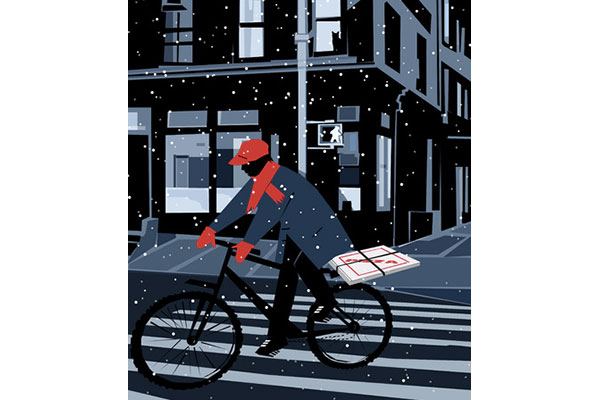
By the time night fell the snow was howling frantically past my window like big gusts of confetti and the only cyclists still out there were delivery guys on mountain bikes grinding through the drifts with bags of Chinese takeout hanging from their handlebars.

chinese takeout


Am I Invisible? Open Call