Skip to content

Posts tagged ‘bicycling’

AM I INVISIBLE? NYC | SP : the Exhibition

Scenes from the exhibition and public art installation Am I Invisible? NYC | SP, in New York City and São Paulo, on view from September 15 – November 8, 2015.

Panel discussion at Centro Cultural São Paulo, September 15. Speaking is Nabil Bonduki, Chief of Cultural Affairs, SP

A projection of images submitted to the Am I Invisible? NYC | SP Open Call at the opening party at Delancey Plaza, September 15, 2015.

Panel discussion at Centro Cultural São Paulo, September 15. From left to right: (L-R) Nabil Bonduki (Chief of Cultural Affairs in São Paulo), Ignacio Aronovich (LostArt), Ronaldo Tonobohn (Department of Transportation), Anderson Augusto (6eMeia), Leonardo Delafuente (6eMeia) and Baixo Ribeiro (Instituto Choque Cultural). Speaking, Anderson Augusto of 6meia.

A visitor to the installation at Delancey Plaza, NYC, September 15, 2015. Works visible (L – R) Gustavo Gomes, Jessica Findley, David Horvitz, Bijari.

Wide view of Invisìvel? SP | NYC at Centro Cultural São Paulo. Works visible by (L – R) William Lamson, Jessica Findley

Visitors to Am I Invisible? NYC | SP October 10, 2015 look at works by Jessica Findley, Gustavo Gomes. Partially visible at extreme left, 6meia.

A visitor to Am I Invisible? NYC | SP takes a picture at Lomography Gallery, NYC, October 10. L-R: works by William Lamson, Hai Zhang.

Public art installation of Invisìvel? SP | NYC with work by William Lamson

Visitors to Am I Invisible? NYC | SP at Lomography Gallery, NYC, October 10, 2015

Public art installation of Invisìvel? SP | NYC with work by Jessica Findley


CONGRATULATIONS! PARABENS!

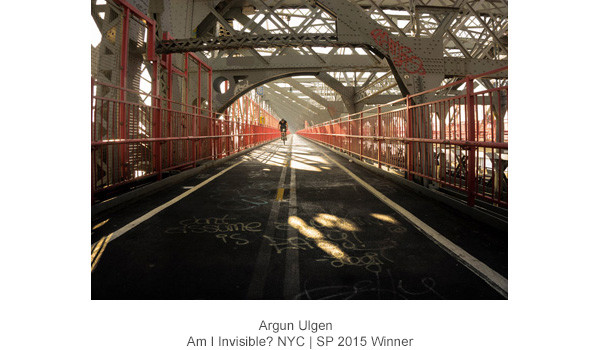
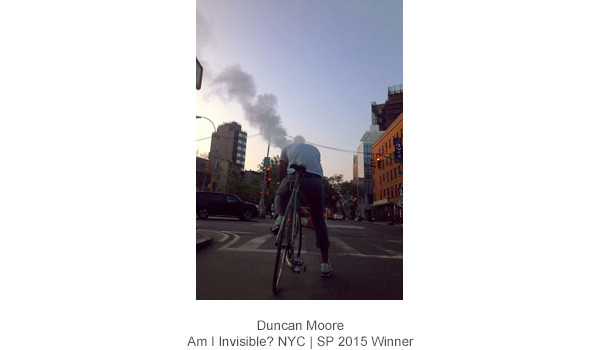
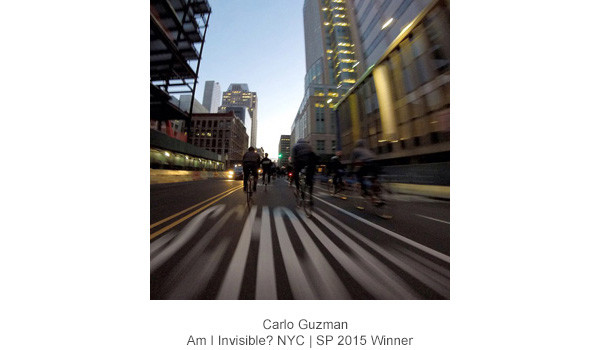
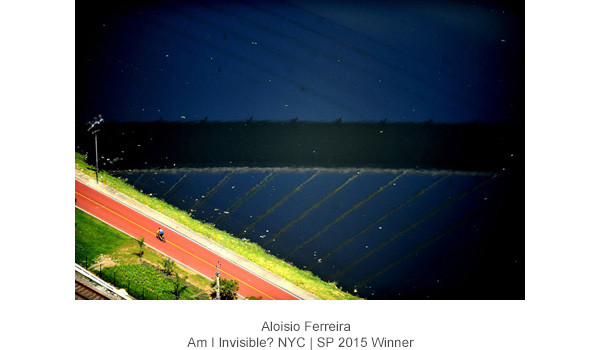
Congratulations! To the winners of the 2015 Am I Invisible? NYC | SP Open Call

Please join Bicycle Utopia and Ciclo Utopia in honoring the six recipients of the jury’s decision.

Parabéns aos vencedores do concurso Invisível? SP | NYC 2015!

Por favor, junte-se à Bicycle Utopia e à Ciclo Utopia na saudação aos seis escolhidos pelo júri.

097- Argun Ulgen

099-Duncan Moore

112-Carlo Guzman

284 Aloisio Ferreira

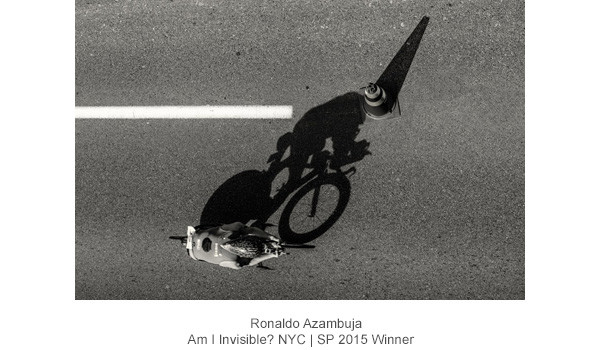
11113 Ronaldo Azambuja

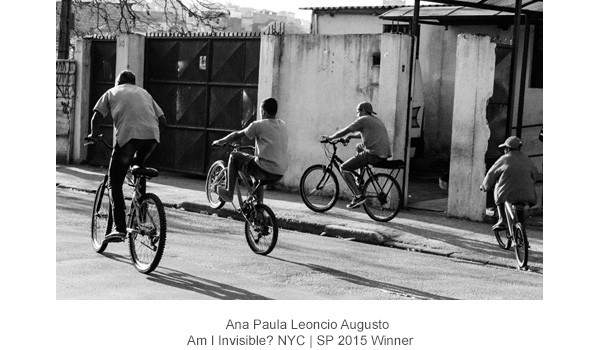
11180 Ana Paula Leoncio Augusto
In São Paulo:
Ana Paula Leoncio Augusto
Aloisio Ferreira
Ronaldo Azambuja

In New York:
Carlo Guzman
Duncan Moore
Argun Ulgen

Many, many thanks to all who entered the Open Call. Your vision and creativity is an inspiration to everyone who envisions a “bicycle utopia” in New York and São Paulo.

We extend our heartfelt thanks to the jury panels in New York and São Paulo:

Daniele Dal Col, Director, Galeria Superfície, São Paulo

Renata Falzoni, Architect, Journalist and Bicycling Advocate, São Paulo

Zanna Gilbert, Department of Drawings at the Museum of Modern Art, New York

Elcio Ohnuma, Department Chair of Photography, Escola Panamericana de Arte, São Paulo

Karen Overton, Executive Director, Recycle-A-Bicycle, New York

Louise Weinberg, Curator, Queens Museum of Art, New York

And a big thank you to all our sponsors, without whom the Am I Invisible? NYC | SP Open Call would not be possible.

Parabéns aos vencedores do concurso Invisível? SP | NYC 2015! Por favor, junte-se à Bicycle Utopia e à Ciclo Utopia na saudação aos seis escolhidos pelo júri. Em São Paulo: Ana Paula Leoncio Augusto.jpg Aloisio Ferreira.jpg Ronaldo Azambuja.jpg Em Nova York: Carlo Guzman Duncan Moore Argun Ulgen Agradecemos muito a todos que participaram do concurso. Sua visão e criatividade são uma inspiração para todos que desejam uma “utopia ciclística” em Nova York e São Paulo. Estendemos também nossos sinceros agradecimentos aos jurados de Nova York e São Paulo: Daniele Dal Col, Diretora da Galeria Superfície, São Paulo Renata Falzoni, Arquiteta, Jornalista e Defensora do Ciclismo, São Paulo Zanna Gilbert, Departamento de Desenhos do Museu de Arte Moderna, Nova York Elcio Ohnuma, Chefe do Departamento de Fotografia, Escola Panamericana de Arte, São Paulo Karen Overton, Diretora Executiva, Recycle-A-Bicycle, Nova York Louise Weinberg, Curadora, Museu de Arte do Queens, Nova York E muito obrigado a todos os nossos patrocinadores, sem os quais o concurso Invisível? SP | NYC não seria possível.

ami nyc sp mailchimp sponsors logos-01

Brooklyn, Geniuses Everywhere

When the change of the season comes to Brooklyn, the geniuses come out;  too many to name or even count. Drinking coffee, hurrying to the subway, taking a number at the butcher’s or standing on the sidewalk, staring down at who knows what. In coffices, geniuses come and go, plugged into devices pouring into their ears the soundtracks of their lives while they write the stories of their lives. Some of these stories are in color; some are in code.

Where ships once grew, now delicious things to eat sprout from the rooftop farms of shipyards, stadiums, on 596 acres and in garages. The harvest doesn’t travel far, turning up in nearby plates in exotic or comforting combinations dished out by arms with tattoos. The names of these morels and morsels combine two languages or more, or the names of dead geniuses.

 steamboat003

There is a building on Jay Street stuffed to the rafters with geniuses making the future. If you’re one of these, and your name is Robert Fulton, and the year is 1807, as the steam rolls off your morning cup of coffee you might say to yourself, “This would be a good way to push a boat around.” At the next table, if it were 1881 and if your name is Arbuckle, the future might appear to you in the form of roasted coffee beans packed ever so neatly in one-pound bags. In either case, you would be hanging around the same corner of Jay Street that you probably are right now.

coffee cup002-01 The first genius of Brooklyn was sugar. But even before that, there was the Dutch genius, and even before that, the genius of the Lenape.

lenape house-01The Lenape’s Brooklyn was much like today: from one end to the other, an endless round of roving supper clubs where diners enjoyed only the most locally grown and seasonal of nightly feasts. In autumn, summer clambakes and fish fries in Coney Island gave way  to beaneries and bakeoffs in the fields of Gowanus.  With the first snow, the forests of Flatbush Extension smoked with barbecues of turkey and deer.

 The Lenape, in their genius, combined the lifestyle of the 1% with that of can-collecting residents of refrigerator boxes. The Lenape supper club was more like supper camp since the Lenape just set up a new house wherever dinner was to be served. They invented Bitcoin, which they called “sewan”, the only difference being that their Bitcoin was made not of one’s and zero’s contained in glowing boxes, but rather seashells mined during strolls along the sandy beaches of the wildly popular open-source operating system called Nature.

 For about 6,000 years, the scene was low-key but copacetic; one season rolling into the next much like the one before, when, one day, up floated the most unusual party boat the Lenape had ever seen. The men aboard were no less exotic, their unearthly pallor set off by dark clothes flashing with beautiful metal ornaments and, I mean, who wears a ruff?

Their boat was strewn with a collection of gadgets each one more entertaining than the last: exploding sticks that dropped a deer with one bang, steel axes and needles that cut effortlessly through wood and leather, and drinks that made your head feel first like it would burst into flames, then like it was floating 10 feet above the ground.

 The Dutch–who had been hoping to shorten the distance between Indonesian nutmeg, Japanese silver and Chinese porcelain and the docks and counting houses of London–looked with some surprise upon the Lenape and saw one thing: fur.

 For a while, the Lenape were the life of the party on both sides of the Atlantic; then the beaver, otter and mink ran out. At the same time, the value of their Bitcoin took a nosedive. To top things off, the Lenape realized they had been trading furs and sewan not only for guns and steel needles, but land.

Too late. They found themselves first in Canarsie, then Oklahoma.

Never mind that. The new genius in town was sugar. Without sugar, once New Netherlands had been emptied of fur, the Dutch would simply have sailed on to other spicier, silkier shores, and we would not now be growing on our rooftop farms the finer ingredients of the pancakes, waffles, doughnuts, coleslaw and pretzels we so enjoy at our barbecues, bean tosses and clam bakes in Greenpoint and Boswijk.

clam and quahog shells-01 War, war, war. European kings and queens, like so many Islamic fundamentalists and Neo-Cons, couldn’t get enough of it. Trying to escape the misery of the Seven Years War, the Thirty Years War, the War of the Roses not to mention the Hundred Years War, a flood of terrorized farmers fled hither and thither across blood-soaked France, Belgium, and Spain to England, from England to Scotland and back again. Where to go, where to hide?

If you could make it to Amsterdam, the Dutch West Indies Company was giving anyone willing to cross over the Atlantic a six-year lease on a Brooklyn homestead, equipped with house, barn, tools and farming implements, four horses, four cows, sheep and pigs, in exchange for nothing more than a promise to stay for six years and the return of one cow, 80 pounds of butter and $40 annually. French Huguenots, Calvinist Walloons, Palatinate Germans, Austrians, Danes, Swedes, Norwegians, Poles and Jews everywhere said, “Sign me up!”

dutch farmhouse003-01Thusly, in the matter of its glot, that of Brooklyn has always been markedly poly, the speakers of 18 languages turning up all at once with a few sewing needles and one suit of clothes, keen to plow the fields of Red Hook.

alice sugar + smoke-01Sugar was the dot-com boom, the Colombian cocaine trade, the subprime mortgage bubble of the 17th century. It combined the irrational exuberance and insatiable demand of the first two with new innovations in cruelty of the third.  Everybody wanted in, and adventurers from Denmark to Spain flocked to the Caribbean to get their piece of the smokiest, stickiest, tooth-rottingest get-rich-quick deal ever produced of pure human misery.

Once every inch of land between Florida and Brazil was covered with undulating fields of sugar cane, there remained the problem to feed, clothe and shelter the humans planting, harvesting and cracking the whip over it. The farms and forests of Brooklyn and Queens furnished the needed supplies. After the Molasses Act of 1733, the sending out of lumber and wheat, the taking in of barrels of molasses and lemons, limes, ginger, people and whatever else smugglers, pirates and other astute men of business, extract from the Caribbean to sell in London by way of New York transformed a street next to a wall into Wall Street.

Brooklyn settled down into a bucolic, homey kind of existence populated by farmers and woodcutters, brewers and distillers, herders and hunters, coffee drinkers and other inventors of the future–a place where one might turn one’s attention, uninterrupted by anything more disturbing than a ferry trip across the river to replenish the cigarette supply–to such pleasant pastimes as the decoding of the Rosetta Stone or the invention of free verse.

walt truman fultonlanding-01

 A minor genius, the Salieri to the Mozart that was sugar, was the Revolutionary War, during which New Yorkers–occupied by the British–continued to buy and sell, grow and trade, and especially,under the protection of the British fleet, come and go, rather than dragging cannons over one snowy mountain after another, feet covered with bloody rags. Among those coming were Africans slaves running from the freedom fighters, promised their freedom if only they would fight on the British side against their former owners. Although recognizing the distinct usefulness of a few slaves around the house, the store and the workshop, New Yorkers were disgusted by the vulgarity of owning dozens if not hundreds of slaves that characterized the plantation slavery system, which, perfected in the cane fields of the Caribbean,  proved so profitable in the cotton fields of the nascent democracy.

They also had  few objections to the purchase or inheritance of freedom, nor to worship nor literacy, baptism, or the owning of property on the part of African slaves from the time of the first Dutch settlers. By 1818, the Bridge Street African Methodist Episcopal Wesleyan Church had been founded on Bridge Street by blacks fed up with sitting in the back rows of white churches.

And this is how greatest American genius of all, contradiction, came to Brooklyn.

genius brochette-01

A Visit to Bicycle Roots Bike Shop in Crown Heights

[tentblogger-vimeo 83435758]

What’s different about New York City from Central Illinois? Artist Kathy Creutzburg pays a visit to Joe, Nechama, Herschel and Steven at Bicycle Roots Bike Shop in Crown Heights, Brooklyn.


About this Sponsored Post

In addition to our regular content, we occasionally post special offers and promotions from our subscribers.

Highlights From Last Week’s East Harlem Art and Culture BikeART Tour

[tentblogger-vimeo 83622121]

Great weather, great art, great food, site-specific spoken-word performances by JC Augustin, and wonderful music by Blue Maky at the East Harlem Harvest Festival were just some of the highlights of the BikeART tour on Saturday, October 27.

We’re looking forward to more of the same and just more on Saturday, November 2 for the Day of the Dead tour!

Sign up here!

October 27th East Harlem BikeART Tours: Play(LABS)!

baddermural

Muralist, graffiti and tattoo artist Badder Israel puts the finishing touches on “Yellow Brick Road” his tribute to the cultures of the Indians of the Americas–Maya, Inca, Aztec and Taino. The mural is part of Play(LABS), a public art installation in four East Harlem community gardens, organized by the West Harlem Art Fund and New York Restoration Project.

Join us on Sunday, October 27th on our bike tour! Starting from the East Harlem Café we’ll make stops at Play(LABS) and other art and culture locations, the East Harlem Harvest Festival. We’ll taste some great food, listen to some great music–it’s going to be a great day to be in Harlem!

Tours start at 10 am and 2 pm.

For more information, and to book a tour, go here.

Bike Share Part I: New York and Paris, the Same Only Different

New York and Paris. So different and yet somehow so alike.

In New York, everyone speaks some version of English, even if the speaker’s vocabulary may be limited to, “I’m sorry I don’t speak English.”

In Paris everyone speaks French and it’s not because they really can speak English and just don’t want to.

A case that proves the point: the Parisian dog-owner. When Monsieur or Madame calls out “Viens ici!” the animal scampers right up. Surely even the British, that most animal-loving of nations, and, along with Americans and Australians, among the last mono-lingual cultures on Earth,  do not suppose that French dogs are bi-lingual.

In New York, dogs, like cars, croissants and everything else, are larger than the Parisian. Canine New Yorkers watch TV all day alone in their apartments, relying on people dropping by occasionally to open cans and doors, sleep with, bark at and accompany them when they venture  outside. If there’s a sale on, dogs in New York enjoy taking the subway to Bloomingdales, dressing for the occasion in plaid jackets and riding in shiny black vinyl sacks carried by their humans.
bilingual dogs
In Paris, if you are a lady, and a man opens a door for you–which all men, without exception, do (another difference), it is proper to say “Pardon” and not “Merci,” to show you have not confused gallantry with service.

In a Parisian restaurant, it is possible to carry on a conversation without being obliged to shout over loud music and even louder fellow diners. The waiter will never ask you, while you are chewing a mouth full of food, whether you have finished eating, nor will your empty plate be removed before everyone else at the table has put down their fork and knife.

And thank heavens this is not the case in New York. Half the city’s gastroenterologists and hearing aid manufacturers would be put out of business. Just another example of American superiority over the French,in keeping productivity high and unemployment low.

“Pardon” is French for “Excuse me.” When the word is spoken for the purpose of making one’s way through a crowd of people, it means “Having spoken, I will now stop and wait for you to make an adjustment to your spatial orientation which will allow me to pass.” The speaker then suspends all forward motion while the obstructing human moves out of the way. Once the path is clear, forward motion is resumed.

In New York the concept is more spiritual in nature. The words are spoken like some magic charm the utterance of which, while shoving to the right and left, not to say trampling over, inconveniently slow or stationary men, women and children, absolves the speaker of any hint or blot of rudeness such pushing, shoving and trampling the pusher, shover or trampler might otherwise incur.

On those unfortunate occasions when the New York interpretation of “Excuse me” is addressed by a bicyclist toward a motor vehicle, its flaws become immediately apparent. Just as no one in Paris, nor indeed in all of France, ever believed Saddam Hussein had weapons of mass destruction, or that the physique of the giraffe or the penguin are the result of a Divine Plan, so it must be conceded that in the matter of “Excuse me,” the French usage has distinct advantages over that which prevails in the great city of New York. In this particular case, one hopes for less, rather than more, courtesy.

As they say, Vive la différence.

Turning to geography, one notes that Manhattan and Paris are about the same size. Both cities are defined by their waterway. In Paris, the water runs right through the middle of it; in Manhattan, around the sides.

From the point of view of population, about the same number of people live in Paris and Manhattan, quite a large number. With regard to the inevitable space problem, Manhattan residents go in for the taller solution, Parisians favor the smaller.

Two million people live in central Paris, where there are exactly two high rises:the Tour Montparnasse, built in 1973, and the Eiffel Tower, built in 1889.

The Tour Montparnasse was built mainly to improve communications with the Shadoks and the Gibis  who have been trying to get to Earth with their ridiculously miniscule wings since 1968.

tour-montparnasse-shadoks-to-size

The Eiffel Tower was built to demonstrate how steel construction could liberate architectural design from the height limitations of load-bearing walls. In Paris, this spectacular breakthrough in engineering instantly produced a law restricting building height to seven stories within the city center and 20 on the outskirts, a classic case of French “I can but I shan’t.” This cultural characteristic is very useful in an urban agglomeration where 15 million people live crammed into tiny apartments. For if one cannot expand upward, one must divide living space into ever tinier units.

No reticence such as that which inhibited the French afflicted anyone on this side of the Atlantic. Architects and plutocrats alike spoke with one voice to greet the new technology: Yahoo!

The unbuttoned enthusiasm that ensued resulted in ever-taller buildings of such unwholesome design that, following the construction of the 38-story Equitable Life Building in 1915, a law was passed requiring that henceforward, all skyscrapers must be designed so as to allow daylight to reach street level for at least two hours a day.

eiffel-equitable-beekman

Just as it was at one time possible to see the sky from the ground in Manhattan, there was also a time when it was possible, in either Paris or New York, to go out for a pleasant drive around town just to feel the wind in one’s hair, or, within no more than 20 minutes of setting out from the city center, find oneself rolling briskly through green fields. Ah, the Nationale Sept, what have they done to you? Perhaps the Canal de l’Ourcq might be a friend to turn to in your agony.

Both cities now sit at the center of gigantic urban agglomerations of 15 and 20 million people respectively. I myself can’t count higher than the six people I can fit around my dinner table, but I can tell you this: depending on whether you start out by taking the Lexington Avenue Line Uptown or the A train Downtown, one doesn’t really get the feeling of having actually left New York City before reaching Maine or North Carolina. Had you gotten on the F train by mistake, your fate would remain unknown as there is some debate among New Yorkers as to whether or not there actually is anything beyond Philadelphia.

Even if everyone stayed right where they were, 20 million people would still be quite a large crowd. But these hordes do not stay put. The need for employment requires a large portion of them to travel into the city center daily, and then go back home again at night. Somewhere P.T. Barnum is fuming with frustration that he is no longer alive to throw a tent over such a spectacular feat.

Not to be outdone by Jobs, his beautiful twin sister, Leisure, brings in a further 45-50 million visitors per year, for the sole purpose of livening things up when footballs fly through the air or there’s a sale on at Bloomingdale’s.

mickey-met-museum

In 1959,  Jean-Luc Godard made a movie whose plot relied entirely on Paul Belmondo’s ability to  park his car absolutely anywhere and leap out from behind the wheel to  chase Jean Seberg all over Paris, she herself afflicted with a mania for jumping out at stoplights. Unlike Romeo and Juliet, it’s obvious why these two were made for each other.

Twenty years later, Paris was the second most polluted city in Europe after Athens.crammed round the clock with barely moving motor vehicles, horns blaring.

More cars meant more dogs, naturally. If you weren’t sitting, irate, in your car not going anywhere, you were picking your way through so much  Dachsund and Yorkie residue that the Sanitation Department created a custom-built fleet of motorcycles equipped with vacuum hoses designed for the sole purpose of sucking up dog shit.

What to do with all that shit was a problem at first but it seems to have been resolved—nobody knows how. Maybe there is a Yucca Mountain full of crap somewhere, perhaps in some sub-Saharan former colony, or if not that, le Quatre-vingt treize.

Had Paul Belmondo fallen in love with Jean Seberg circa 1980, the first time she jumped out at a stoplight he would have lost her forever while he drove around in circles for hours looking for a place to park instead of running after her. Even if he had found an empty space after a mere two or three hours and a sidetrip to the gas station, the minute he started to run he would have slipped in dog shit, broken his neck and died. It would have taken 90 seconds instead of 90 minutes to tell the story. Scene one, fade to black, roll credits. Trying to drag things out rather than shorten them, Godard never would have hit on the idea of using jump cuts. Today he’d be a cashier in one of those combination Dunkin’ Donuts Exxon stations instead of saying things like “Even when it’s not funny, it’s more funny” to Dick Cavett, who should know what he’s talking about, if anyone does. Only the movie title would stay the same, Breathless, but it would mean something completely different.

More cars, more people, more pets. It will be 1973 all over again,the same only different. It is estimated that by 2030, one million people will move to New York City; 90% of the population of both France and the US will be living in cities. Coughing and honking across the Atlantic,  Manhattan and Paris will each fuse into two giant parking lots, the glow of every streetlamp and headlight surrounded by a misty, romantic glow equal parts carbon emissions and Cromolyn, the sky permanently dark with self-driving helicopters transporting Masters of the Universe to and fro between their citadels of productivity and parking space-sized habitation pods.

cars-+-helicoptersto-size

Or, alternatively, Bike Share. Here again, as ever, New York and Paris, twin souls.

In Paris, before Bike Share, on the best of days, bus drivers used the horn like an improvement to the accelerator, and a reasonable alternative to the brake pedal. On less good days, they urged their municipal steed from depot to depot with a single-minded devotion to speed. Passengers wishing to ascend to or descend from the juggernaut counted as no more than mere insults to be ignored in their passionate pursuit of the greater goal.

jim-shoulders-busFL
About a week after the beginning of Paris Bike Share, I was riding one of these pleasure boats when the vehicle slid up behind a small flock of six or seven wobbly Bike Share cyclists noodling along at about 3.5 miles an hour. Anyone needing to pee or on their way to a sale at La Samaritain would walk twice as fast as these cyclists. I could not believe my eyes, therefore, when the driver slowed the bus to a crawl, taking the occasion to crack the window and, leaning back in his seat, light up a cigarette as we floated up the Boulevard Sebastopol as if on a summer cloud.

In New York, within six weeks of Bike Share, cyclists began marveling among themselves about the “Citibike Zone,” describing it to each other in hushed, awestruck tones as a kind of Shangri-la where motorists drive slowly, carefully and have even been sighted yielding to cyclists at intersections and other barely credible phenomena. I would not believe it if I hadn’t with my own eyes witnessed pedestrians acknowledging the ringing of a bicycle bell with a pleasant smile and a wave, rather than the torrent of obscenities to which the New York City cyclist is accustomed.

Seen from Outer Spac, these blue riders sprinkled throughout the streets make the city look like a field of blue-eyed grass. A kind of serene dignity attends the pinball-like trajectory that characterizes the more or less forward motion of these cyclists, and a far-off gaze hints at great minds filled with more important things than the nonchalant revolution they carry out with arms outstretched to welcome the future that is now, and legs spinning at speeds that recall why Tex Avery is so beloved by all.

Paris Bike Share celebrated its fifth summer this year: 250,000 annual memberships, 1.3 million rentals in 2012, and fewer accidents than any other mode of transport, including cyclists using their own equipment, with a total of six fatalities among 130,000,000 Bike Share trips.

New York Bike Share projected 60,000 annual members for its first year. Use surpassed all estimations in the first three months, with 80,000 annual members and, in Auguse an average of 36,000 trips per day. “I actually think you could quadruple what we have now,” said Jon Orcutt, DOT Policy Director at a public discussion  in September.

New York like Paris?


Bikeshare Stations as Urban Furniture

My friend and I were noticing how Citibike stations are becoming informal gathering places, functioning somewhere between generic cialis price compare a park bench and a stoop.

Or in this case, temporary pet storage.

denton_taylor_citibike_chihauha
Photo: Denton Taylor

Lumen Video and Performance Festival 2013

If you aren’t going to make it to the Venice Biennale this year (I knew I should have reserved that hotel room 18 months ago), on June 15 you can see a piece of it on Staten Island at Lumen, one of New York City’s most anticipated art events of the summer.

Dominique_Paul_Migrations-of-the-Arthropods-series-Ready-to-Float_2012_courtesy-of-artist

Among the fifty artists exhibiting video and performance art projected in and around Lyons Pool is Jose Carlos Casado, whose Off was shown in May for the opening of the Biennale. Also of note at Lumen this year, Scott Van Campen’s Cicada Machine, work by Margaret Cogswell, , Yorgo Alexopoulos, the amazing Jonathan Ehrenberg, DD’s re-animation of It Came From Beneath the Sea.

It_Came_From_Beneath_The_Sea_poster

Curated this year by David C. Terry and Esther Neff, Lumen is a chance to see an eclectic collection of video and performance art from around the world in the magical atmosphere that is Staten Island By Night.

Any excuse to take the Staten Island Ferry is fine with me valium abuse, whose battered steel and pale-blue fiberglass interiors affords the opportunity to revisit childhood memories of amorous mosquitoes and burnt hot-dogs and marshmallows, not to mention a quick spin on one of the swivel chairs in the mirrored foyer of the women’s bathroom.  And for what glamour of a Broadway first night or cinq à sept are we preparing ourselves for in the middle of New York Bay?

Staten Island is home to not only Lumen, but some of the city’s most intriguing museums, such as the Alice Austen House  and the Jacques Marchais Museum of Tibetan Art. The first is a house that is a museum, the second is a museum in a house designed to resemble a Tibetan monastery.

Enter at the lower level of the Staten Island Ferry if you are coming by bike. Bike valet parking is available at Lumen. For directions, and an overview of some of the other cultural destinations on Staten Island, click on the map below to download the printable pdf.

staten_island_cultural_map_inset

Blondie of Arabia

t.e. lawrence

Monica Hunken moved to NYC two days before September 11 bringing with her a family background that included a failed whistle-blower lawsuit and an intrepid immigrant grandfather.  These turned out to be fertile soil for the agit-prop street theatre, political action and bike culture that flourished in the wake of the World Trade Center attacks, the Afghanistan and Iraq invasions and the 2004 RNC protests.

In 2010, inspired by Follow the Women, group ride for human rights that takes place in the Middle East annually, and enabled by a serendipitous catering gig in Qatar that provided the starting point, she embarked on a 6-week solo bicycle trip across Egypt, Jordan and Syria.

A brief description of this gay outing to a longtime peace activist friend elicited “That must have been quite a shock for the locals.” Truer words were never spoken. But it’s amazing what a six-foot tall blonde American can get valium for felines away with in a region whose inhabitants are bound, on the one hand, by the laws of hospitality, and, on the other, intimate knowledge and fear of the weight and caprice of American state power.

Bringing a “disconcerting American optimism” as she set off just a few weeks before the debut of the Arab Spring, Blondie of Arabia pedaled right into the very heart of the cultural-social maelstrom that is the Middle East, blueballing a series of gallant gentlemen along the way and blithely delivering a terrific whack to any number of gender clichés and hetero-normative sexual political assumptions nestling in a bouquet of  Orientalist geo-political post-colonial paradigms and islamo-phobias, as only a woman riding a bicycle alone through Aqaba can.

Safely back on Bleecker Street three years later, she plays it all for laughs for a brisk and thought-provoking hour at Culture Project, nightly through May 11.

monicahukenphoto-main