One More Week to Summer Streets!
We can’t wait! For more information, go xanax prescription here

Park Ave, Jeff Prant, photographer

Jul 26
We can’t wait! For more information, go xanax prescription here
Park Ave, Jeff Prant, photographer
My friend and I were noticing how Citibike stations are becoming informal gathering places, functioning somewhere between generic cialis price compare a park bench and a stoop.
Or in this case, temporary pet storage.
If you aren’t going to make it to the Venice Biennale this year (I knew I should have reserved that hotel room 18 months ago), on June 15 you can see a piece of it on Staten Island at Lumen, one of New York City’s most anticipated art events of the summer.
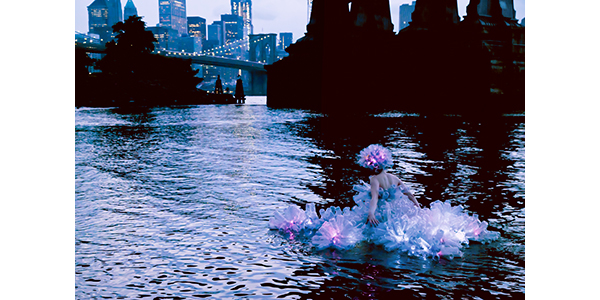
Among the fifty artists exhibiting video and performance art projected in and around Lyons Pool is Jose Carlos Casado, whose Off was shown in May for the opening of the Biennale. Also of note at Lumen this year, Scott Van Campen’s Cicada Machine, work by Margaret Cogswell, , Yorgo Alexopoulos, the amazing Jonathan Ehrenberg, DD’s re-animation of It Came From Beneath the Sea.

Curated this year by David C. Terry and Esther Neff, Lumen is a chance to see an eclectic collection of video and performance art from around the world in the magical atmosphere that is Staten Island By Night.
Any excuse to take the Staten Island Ferry is fine with me valium abuse, whose battered steel and pale-blue fiberglass interiors affords the opportunity to revisit childhood memories of amorous mosquitoes and burnt hot-dogs and marshmallows, not to mention a quick spin on one of the swivel chairs in the mirrored foyer of the women’s bathroom. And for what glamour of a Broadway first night or cinq à sept are we preparing ourselves for in the middle of New York Bay?
Staten Island is home to not only Lumen, but some of the city’s most intriguing museums, such as the Alice Austen House and the Jacques Marchais Museum of Tibetan Art. The first is a house that is a museum, the second is a museum in a house designed to resemble a Tibetan monastery.
Enter at the lower level of the Staten Island Ferry if you are coming by bike. Bike valet parking is available at Lumen. For directions, and an overview of some of the other cultural destinations on Staten Island, click on the map below to download the printable pdf.

Animals roller skating or dressed as airline pilots make me sad, and human beings walking on a wire at great heights or diving into tiny buckets of water fill me with terror, but no delight. A circus-themed childhood nightmare involving frothing alligators, sequined ladies, a sinister jar of pickles, and…well, the mere thought of it even today makes my heart freeze.

No circuses for me, therefore, most definitely not.
How to explain, then, my passion for circus art? For what Einstein was to physics, so is circus art to the art of the poster.

The announcement in the New York Times of an exhibition at the Bard Graduate Center The Circus and the City had me on the phone in an instant to the painter Frédéric Lère.

Apart from supreme distinction of having three accents in his name, Frédéric has quite a pronounced circus theme in his work, not to mention a French trapeze artist grandfather. A few days later we were standing together at the entrance of 18 W 86th street.
Well, not exactly together. We waited for each other for 20 minutes at a distance of about six feet, one so absorbed in the catalogue (me) and the, other unable to resist taking a peek into the first room and then transfixed as if before the Oracle at Delphi (Frédéric), that neither of us were able to perceive the presence of the other, even as we both wondered whether we hadn’t gotten the time or the day wrong. The spell was broken only when we, almost simultaneously, pulled out our cell phones, and looking up as we waited for the first ring, found ourselves gazing into each other’s eyes.

Frédéric lives in a fantastic world of esoteric and astonishing facts peopled with extraordinary personalities whose lives defy not only social convention but occasionally the space-time continuum. A stroll through a sequence of rooms whose walls are covered with images of regally bearded ladies and 3-ton golden carriages rolling through Union Square finds him in his element. He is also a rare craftsman with a deep knowledge and keen appreciation of the technical mastery required to produce an article such as The Grand Procession of the Steam Calliope Drawn by a Team of Six Elephants in the City of New York, the details of which he is delightfully willing to share.

A lengthy discussion of registration, wood blocks versus metal plates, paper shrinkage and conservation, the fading properties of ink, or not…time stopped as a magic spell wrapped me up in a moment I would have liked to go on forever.
Then we stopped in front of this, which reminded Frédéric of something. It reminded me of something, too. “Maybe it wasn’t just a dream…” I thought, and the hair on the back of my neck stood up in a braid.
Fortunately, Frédéric was talking, and I tore my thoughts from the abyss reeling before my mind’s eye to give him my full attention. When with Frédéric, this is best. He speaks quietly and quickly, and if you let your mind wander for even an instant, when you come back you will find you have completely lost the thread.

“A while back, when I was going to Moscow a lot for work, I met a girl who ended up marrying the pal I worked with. They eventually moved here. Little by little, she brought her whole family over.
“Her sister married a guy who had an alligator farm, and they went to live in Florida. She started doing a show in which she fought with an alligator. ”
At this point he had to stop to laugh at the mental image of the sister of the pal’s girlfriend in a bikini combatting an alligator, a laugh made of equal parts delight, astonishment, and maybe a little sadness.
“It’s incredible, these people who come here wanting nothing more than a normal life. All she wanted was to escape the Hell that was life in Russia for a quiet, ordinary existence, and she ends up in Florida fighting alligators…
“She was a very unassuming kind of person…in a room full of people, you wouldn’t notice her. She had a couple of kids… Over the years I’ve sort of lost touch with them. I think we’re Facebook friends.”
And he laughed again, shaking his head.

Frédéric Lère
A few weeks later, I met Frederic at his studio, where he was in the middle of creating an enormous wall mural for La Bergamote’s new shop in Midtown. He was on a terrifically tight deadline, so I brought lunch.
“French Dip. That’s a first.” he said, taking a bite.
“Do you know why it’s called that?” I asked. “There’s nothing like it in France, as far as I know.”
“Nothing,” he agreed. “Maybe it’s the baguette?”
He picked up a small paper bag lying on the table where we had spread out the sandwiches.
“The people downstairs make extraordinary chocolate, he said, picking up the remains of a bar. “This is chocolate à la bergamote. I’ve managed to hold on to this, three squares, for two days–we’ll have it for dessert.
“It’s an old story, the story of bergamot, it’s very bizarre. Attempts to export these bergamot candies were never successful. They’re a specialty of Nancy. The Duke of Lorraine, Stanislaus, was the King of Sicily as well–or the Duke, or something like that– he introduced the bergamot fruit into Nancy. So the pastry chefs of Nancy developed a recipe for bergamot candies. But the problem is, they never exported it; even in France it’s not well known outside the region where Nancy is, the Lorraine.
“Anyway, these two French guys came here, and opened a pastry shop. They named it La Bergamote thinking everyone would be very impressed, but it was a bit of a flop at first.”
“Where do you come from in France?” I asked.
“Tours.”
“And how was that?”
“Profoundly boring. I detested it. When I lived there I had only one goal: leave Tours.
“When I was in art school, I lived with a group of friends in a kind of collective in the center of town, in a building that was slated for demolition.
“In this building there was a doctor’s office–everyone else had been put out–and the owner was trying to get the doctor to leave. There was a lease, and the doctor didn’t want to go.
“So the owner posted a classified ad at the art school ‘Free apartment for rent.’ Wow! When I saw that, I went to valium check it out immediately! And it really was a free apartment. We paid only the electricity, heat, things like that.
“The owner thought that we, being artists, would make a lot of noise and be generally obnoxious, and drive the doctor out. We, on the other hand, realized right away that if we made the doctor leave, we’d have to leave too, so we mustn’t make noise or be a nuisance. We became great friends with the doctor, and we had parties only on Saturday and Sunday, or late at night when he wasn’t there.
“It was a magnificent apartment.”

Frédéric Lère
“My grandfather was born in Paris, he started in the circus very young–he must have been around sixteen– in 1914. Apparently this circus was a hit, and the whole troupe was hired to tour the United States. They came over on a boat, and since this was 1914, during the crossing war was declared. When the ship arrived in New York all the French passengers were told to remain on board, they weren’t allowed to disembark; they had to return to France with the ship because everyone was being called up, it was the mobilisation générale. My grandfather watched his colleagues jump overboard and swim to shore because they didn’t want to go back to fight. But he didn’t jump, thinking that since he was so young he wouldn’t be called up right away, and the war would be over before he was drafted.
“So he returned to France without ever setting foot in the United States.
“But he was called up, and he was in a battalion called the Bataillon de Joinville, which was just for athletes. They didn’t go on combat missions, they just did sports–competitions and demonstrations, things like that–until the Battle of Verdun when they said, the time for fun and games is over! Now we need everyone. He was wounded, he took a bullet in the head. He had a scar, a kind of indentation, on his forehead. And after that the trapeze, it was finished for him.
“After the war, since he was from the Auvergne, which meant the whole family was in show business, he opened a boîte, a place like a cabaret or a nightclub. He performed there, and of course he had all his connections with circus people. Then, during WWII, when everyone fled Paris, he went to Tours. After the war he stayed on, and set up again there.
“When I was growing up, we all lived together, on a farm. My grandparents lived in a big house behind ours. It was wonderful. I didn’t get on with my parents very well, so I was always going to stay with my grandparents in their big old house behind our house.
“One day my grandfather bought a gymnastic apparatus with a trapeze, knotted cords, rings, smooth cords–everything for practicing circus numbers. It was an enormous thing. He said, ‘Now I’m going to show you all what I know how to do.’
“He got all dressed up in his trapeze costume and climbed on the apparatus where he struck a few poses, he did a few pirouettes–and then he fell.
“No one ever used that apparatus after that–we were all afraid of it.
“Because of that experience, I had a rather ambivalent perception of the circus. My grandfather talked about it as something absolutely fantastic, with all his stories of voyages and things he’d seen, but in fact, all I ever saw of it myself was the dangerous side.
“The first circus in my own work came about when I was doing frescoes. I found the process of fresco painting so dangerous, I said to myself I must paint something really dangerous to express the danger of the fresco itself, so I painted circus performers, always in poses of delicate equilibrium.
“In fresco painting, you have up to five hours to paint, and after that it’s over, finished! You can’t correct or add anything. The fresco is done. Everything that is wrong, well, it’s there–all the flaws are there, right along with whatever came out well. It’s a real balancing act. You start at one end of the cord, and you walk on a wire across the whole distance of the circus. And if you fall, well then, you fall.
“For La Bergamote, I made a wall mural for their first shop in Chelsea. I liked what they did, but I felt the decor was a bit… cheesy. I felt they needed something a little more French, more traditional –because it’s really traditional and authentic, what they do.
“The most important thing, when you go into a place you like, is that if you can contribute to making it nicer, that in itself is the best reward.
“Then they opened a second boutique on 52nd Street and they decorated it in the same non-descript style as the first one. After only two years the decor was falling apart, so they had to completely redo the place and they asked me to make a new mural.

Frédéric Lère
“Here you have chariot crossing the Place Stanislaus in Nancy, making the first delivery of the bergamot from Calabria.*
“Remember this image of the horse and carriage in the exhibition? I thought it was such a gas, I absolutely had to take that for the point of departure of my mural.
“Instead of the orchestra, here I have the pastry chefs who toss bergamot candies from the chariot into the crowd. And the two people driving the chariot, are, of course, Romain and Stephane, the owners of La Bergamote.
“When I paint, what I want to achieve is not, ‘Look at me, I’m so gorgeous,’ but to express an action.

Frédéric Lère
The arrival of the bergamot in Nancy is on permanent view at La Bergamot , 515 West 52nd Street. The FREEvolous King Lère Show is a public art installation which has been traveling around the world and on the web since December 2012, when it launched at Cup Cake Café. Since then, Frederic has given several small free-standing reliefs of circus scenes to friends who take them around the world.
The tiger act was last seen at the Bouglione Circus in Paris.
To see more of Frédéric’s work, visit his site, or La Bergamote.

On June 18, he will be painting the Empire State Building from the terrace of the Spring Hill Suites in Midtown at 25 W 37th St. from 4 to 7 pm.

Monica Hunken moved to NYC two days before September 11 bringing with her a family background that included a failed whistle-blower lawsuit and an intrepid immigrant grandfather. These turned out to be fertile soil for the agit-prop street theatre, political action and bike culture that flourished in the wake of the World Trade Center attacks, the Afghanistan and Iraq invasions and the 2004 RNC protests.
In 2010, inspired by Follow the Women, group ride for human rights that takes place in the Middle East annually, and enabled by a serendipitous catering gig in Qatar that provided the starting point, she embarked on a 6-week solo bicycle trip across Egypt, Jordan and Syria.
A brief description of this gay outing to a longtime peace activist friend elicited “That must have been quite a shock for the locals.” Truer words were never spoken. But it’s amazing what a six-foot tall blonde American can get valium for felines away with in a region whose inhabitants are bound, on the one hand, by the laws of hospitality, and, on the other, intimate knowledge and fear of the weight and caprice of American state power.
Bringing a “disconcerting American optimism” as she set off just a few weeks before the debut of the Arab Spring, Blondie of Arabia pedaled right into the very heart of the cultural-social maelstrom that is the Middle East, blueballing a series of gallant gentlemen along the way and blithely delivering a terrific whack to any number of gender clichés and hetero-normative sexual political assumptions nestling in a bouquet of Orientalist geo-political post-colonial paradigms and islamo-phobias, as only a woman riding a bicycle alone through Aqaba can.
Safely back on Bleecker Street three years later, she plays it all for laughs for a brisk and thought-provoking hour at Culture Project, nightly through May 11.

Weather. Where would we be without it? That’s what I say when people complain. Think about it: no weather at all. We’d be on the moon.

Weather that makes noise, or piles up, rain, hail, snow, sleet, fog, mist, any and all of these in any combination are my passion. When a friend of mine who lives in another part of the country heard there was a snowstorm in New York that included thunder and lightning she left a voicemail, “You must be in seventh heaven.” And she was right.
Apart from being out in it, my favorite place to find out about the weather is Intellicast, which has interactive maps which to the weather fanatic is like a shot of whiskey to an alcoholic: one is too many and a hundred are not enough. I’m not exactly sure what “interactive” means in this case because you can’t actually do anything on the site to modify the weather. But you can get very detailed information about it, where it’s coming from, how quickly it’s coming, and what kind it is.

Today’s forecast from Intellicast

NASA satellite image of nemo
Nor’easters are among winter’s most ferocious storms. These strong areas of low pressure often form either in the Gulf of Mexico or off the East Coast in the Atlantic Ocean….
In places like New York City and Boston, for instance, if the wintertime low tracks up to the west of these cities, wintry precipitation will often change to rain.
However, if the low moves slightly off the coast to the east of these cities, assuming there is enough moisture and cold air accompanying the storm, Boston and New York will typically get snow or a mixture of precipitation types.
A nor’easter gets its name from its continuously strong northeasterly winds blowing in from the ocean ahead of the storm and over the coastal areas.
The forecast said snow today, and a few tiny flakes were already swirling past the window as I ate my breakfast. When I got on my bike I was wearing my Snow Outfit: a shearling coat over a merino wool sweater, a wool watch cap and two scarves, a silk one beneath a woolen muffler, and of course, The Gloves. By the time I got to the Manhattan side of the bridge I was sweating like a pig.
Straight ahead of me riding up the Bowery was a man dressed for the weather much more appropriately than I in a dapper lightweight gray herringbone tweed jacket. He was riding a bike with upright handlebars and super-skinny tires. At the next light I found myself stopped beside him, well positioned to get a glimpse of the front view, which, just as dapper as the rear, revealed a pleasant, lightly bearded face and stylish rectangular eyeglasses.
“Doesn’t it seem like it might snow later,” I asked.
“It’s supposed to,” he agreed amiably.
“Is that very attractive jacket going to be warm enough?” I asked.
“I have another coat,” he said.
“Where is it?”
“Right here,” he said, patting a knapsack in the basket over his front wheel.
“How about those skinny tires in the snow? What’s that like?”
“I have another bike,” he said, smiling, “that has little metal spikes in the tires.”
“Aha.” I was very impressed by this information. Spiked tires! That’s preparedness for you. “Where is that?”
“In Brooklyn,” he said.
By this time the light had changed, and we were riding down Third Avenue side by side.
Hoping to convey warm interest that would encourage him to say more I said, “Aha.”
We pedaled along for a few minutes in silence as I tried to think what good this bicycle in Brooklyn could possibly do him in the present situation, but I couldn’t figure it out.
“That might not be so convenient later today,” I ventured.
He laughed, and agreed.
” Do you ever take the subway with your bike?” I asked, still trying to figure out what the plan might be. Surely the exceptional foresight that accounts for two bicycles–one with spiked tires no less–would also factor in a plan?
“Yes, but only in extreme emergencies.” His eyebrows come down toward his glasses making his pleasant face look, if not exactly annoyed, very serious. This does its handsome pleasantness no harm whatsoever.
“It’s such a hassle. By the time you lug your bike down into the station and wait for the train, you’d be halfway home already.”
He laughed lightly, as if to say such a problem could not possibly ever concern him, personally. I wonder what he would consider an ‘extreme emergency.’ But we’d approached the corner where I turn off Third Avenue and the light was green, so there was no time to ask.
I laughed, too, hoping to convey sympathetic agreement, and I said, “I turn here. Nice talking to you.”
“Nice talking to you, as well,” he replied, and we glided off in our separate directions.
 I wondered what he was going to do if it did snow more later, with those spiky tires on his other bike at home in Brooklyn. I wondered if that could that be considered an extreme emergency.
As the day went on the wind shifted and the temperature fell. The wet snow of the morning froze beneath the new snow which the wheels of quiet slow cars pushed up into creamy ridges made all the more beautiful by the knowledge that their existence would be so fleeting, ending in a long, slow decline of gurgling black slush.
By the time night fell the snow was howling frantically past my window like big gusts of confetti and the only cyclists still out there were delivery guys on mountain bikes grinding through the drifts with bags of Chinese takeout hanging from their handlebars.


Although there is no shortage of excellent reasons to go there, starting with an astounding collection of museums, not to mention Central Park, one of the greatest gifts of any city to its citizens since the first brick was laid in Mohenjo Daro, trying to get to the Upper East Side on a bicycle, and getting around once you’re there, is difficult.

A very pleasant riverfront bike path will bring you from Whitehall as far as 35th Street, passing, spectacularly, beneath the Brooklyn, Manhattan and Williamsburg bridges, along the way. Sadly, a few blocks beyond the splendid new East River Ferry Terminal, the idyll ends in a trash-filled cul-de-sac.
Further progress uptown requires heading inland where the choices will inevitably come down to First and Park Avenues, both highways.
Despite the recent installation of a bike lane on First Avenue, which is a pure delight on the weekend when there is no traffic at all and it is routine to sunbathe, or barbecue, or play every single one of Bach’s Goldberg Variations, or all three, simultaneously or consecutively, in the middle of that most spacious thoroughfare without the worry of being disturbed by a single automobile, or elephant, or even the police. Apart from these golden moments, I cannot, however, recommend this noblest of bike lanes, “sharrowed” as it is at several points by ramps and routes delivering motorists who will not even see you as they careen toward Queens and Long Island, so bedazzled is their mind’s eye by visions of the joys that await them in those Valhallas beyond tunnel and bridge.

As in Midtown, bike lanes are few, but unlike that chaotic throng of highways masquerading as city streets, traffic above 59th Street is usually light and as such in thrall to frantic motorists trying to make all the green lights between the Bronx and the Mid-Town Tunnel.
Are there elephants in that tunnel, or something?
Only sometimes. And were this a regular thing, it would just be one more thing to complain about.
So what’s the rush?

If accidents, whether provoked by bicyclist or motorist, are generally the result of moving faster than the brain can send instructions to the body, between the euphoria of the speeding motorist and the apoplexy of the traffic jam, I prefer the perils of the latter. The damage inflicted by the most neurasthenic cabdriver advancing at 15 miles an hour will be preferable to that of the gayest motorist roaring along at 50 miles an hour in a 30 mile zone.
This is bicycling on the Upper East Side. Possibly a situation that will always be less than ideal. One might get the impression we are just not wanted.
Things being what they are, I say, take Park Avenue.

One evening a couple summers ago I found myself stopped at the light at Park and 42nd alongside a pedicab driver. If anyone knows the best way to get to the Upper East Side on a bicycle, I thought, it’s this guy.
“Hello,” I said, experimentally.
“Hello!” replied the driver brightly.
The two people seated in the cab flicked a glance in our direction, then paid no more attention to us.
“Can I ask you a question?” I said. And I laid my case before him.
“Sure!” He nodded affably. “Just go up here, turn left, then right onto Vanderbilt, then india generic cialis right again on 46th, and you’ll be right back on Park. What’s your name?”
I told him.
“Harry,” he said, pointing at his chest. He was in fact quite hairy, in the manner of a guy who likes to wear colorful large-patterned shirts that show off to their best advantage a springy crown of sun-bleached hair framing a ruddy outdoor complexion. He was wearing one of these. Large orange flowers bloomed on an eye-popping yellow background.
“Your hair is great,” he added.
I thanked him, and returned the compliment.
The light changed and we pushed off.
“How do you like that job?” I asked, taking advantage of slow-moving traffic to ride alongside him.
“It’s alright,” he said, “It’s good.”
“What about the winter?”
“In the winter I’m in Florida!” he said with the wide grin of a man who has no prejudice against sloth, yet has never in his entire life been bored for even one second.
“And the summer it’s really nice, you’re outside, the money’s good…”
We turned left on 42nd, and I had to pull ahead of him until we turned into Vanderbilt Street.
Thinking more about the interrupted conversation behind me than what lay ahead, I kept going straight instead of turning where he’d told me to.
“Jeanne!” I turned to find Harry waving broadly toward the right as he turned into 46th Street.
I waved back, but I didn’t see him again.

It’s unfortunate that the Museum of Art and Design has such a dull name–and somehow MAD doesn’t seem like it will ever have the appeal of “MoMA” or “The Met”–because it is one of the city’s most beautifully proportioned museum, inside and out, in both form and substance.
There are far too many museums on the so-called Museum Mile than you could possible visit in one day or three, even should you scurry through the galleries of, say, MoMA strictly refraining from even a glance at the art as you conscientiously photograph each and every one of the wall labels with your smartphone.
When I saw this I was in the company of a friend visiting from out of town. We got a terrific laugh out of it, once we recovered from the slack-jawed staring. Few things in life are as delightful as a good laugh in a place where one isn’t supposed to even smile, much less find anything funny. When I’m dead it’s one of the things I’ll miss the most.
Without looking quite so far ahead, unless you are a memory expert, visiting more than two museums a day is pointless, and of these, one of them should be on the small side. If you employ this method: one large museum plus one small one, between the two a pleasant snack and ending with a breezy roll around Central Park to wind things up, in a minimum of three months of weekends you will have visited them all, and it will be time to start over.
Although possibly empty of Vermeers, Michelangelos or Monets, each of the city’s smaller museums will reveal to the visitor something which can never be spoiled by over-familiarity or anticipation: surprise.
As for the Museum of the City of New York itself, you really have to wonder how they managed to fit the entire city in a single building.
It must have quite a large basement.


Copyright © 2026 . All rights reserved.
