Skip to content

Posts from the ‘Art’ Category

A Yankee Circus on Mars

Animals roller skating or dressed as airline pilots make me sad, and human beings walking on a wire at great heights or diving into tiny buckets of water fill me with terror, but no delight. A circus-themed childhood nightmare involving frothing alligators, sequined ladies,  a sinister jar of pickles, and…well, the mere thought of it even today makes my heart freeze.

human_projectile

No circuses for me, therefore, most definitely not.

How to explain, then, my passion for circus art? For what Einstein was to physics, so is circus art to the art of the poster.

elephant_laila

The announcement in the New York Times of an exhibition at the Bard Graduate Center The Circus and the City had me on the phone in an instant to the painter Frédéric Lère.

nixon_circus

Apart from supreme distinction of having three accents in his name, Frédéric has quite a pronounced circus theme in his work, not to mention a French trapeze artist grandfather. A few days later we were standing together at the entrance of 18 W 86th street.

Well, not exactly together. We waited for each other for 20 minutes at a distance of about six feet, one so absorbed in the catalogue (me) and the, other unable to resist taking a peek into the first room and then  transfixed as if before the Oracle at Delphi (Frédéric), that neither of us were able to perceive the presence of the other, even as we both wondered whether we hadn’t gotten the time or the day wrong.  The spell was broken only when we, almost simultaneously, pulled out our cell phones, and looking up as we waited for the first ring, found ourselves gazing into each other’s eyes.

circus_picture_puzzle
Frédéric lives in a fantastic world of esoteric and astonishing facts peopled with extraordinary personalities whose lives defy not only social convention but occasionally the space-time continuum. A stroll through a sequence of rooms whose walls are covered with images of regally bearded ladies and 3-ton golden carriages rolling through Union Square finds him in his element.  He is also a rare craftsman with a deep knowledge and keen appreciation of the technical mastery required to produce an article such as The Grand Procession of the Steam Calliope Drawn by a Team of Six Elephants in the City of New York, the details of which he is delightfully willing to share.
grand_procession

A lengthy discussion of registration, wood blocks versus metal plates, paper shrinkage and conservation, the fading properties of ink, or not…time stopped as a magic spell wrapped me up in a moment I would have liked to go on forever.

Then we stopped in front of this,  which reminded Frédéric of something. It reminded me of something, too. “Maybe it wasn’t just a dream…” I thought, and the hair on the back of my neck stood up in a braid.

Fortunately, Frédéric was talking, and I tore my thoughts from the abyss reeling before my mind’s eye to give him my full attention. When with Frédéric, this is best. He speaks quietly and quickly, and if you let your mind wander for even an instant, when you come back you will find you have completely lost the thread.

miss_louise

“A while back, when I was going to Moscow a lot for work,  I met a girl who ended up marrying the pal I worked with. They eventually moved here. Little by little, she brought  her whole family over.

“Her sister married a guy who had an alligator farm, and they went to live in Florida. She started doing a show in which she fought with an alligator. ”

At this point he had to stop to laugh at the mental image of the sister of the pal’s girlfriend in a bikini combatting an alligator, a laugh made of equal parts delight, astonishment, and maybe a little sadness.

“It’s incredible, these people who come here wanting nothing more than a normal life. All she wanted was to escape the Hell that was life in Russia for a quiet, ordinary existence, and she ends up in Florida fighting alligators…

“She was a very unassuming kind of person…in a room full of people, you wouldn’t notice her. She had a couple of kids… Over the years I’ve sort of lost touch with them. I think we’re Facebook friends.”

And he laughed again, shaking his head.

f_lere_shanghai

Frédéric Lère

A few weeks later, I met Frederic at his studio, where he was in the middle of creating an enormous wall mural for La Bergamote’s new shop in Midtown. He was on a terrifically tight deadline, so I brought lunch.

“French Dip. That’s a first.”  he said, taking a bite.

“Do you know why it’s called that?” I asked. “There’s nothing like it in France, as far as I know.”

“Nothing,” he agreed. “Maybe it’s the baguette?”

He picked up a small paper bag lying on the table where we had spread out the sandwiches.

“The people downstairs make extraordinary chocolate, he said, picking up the remains of a bar. “This is chocolate à la bergamote.  I’ve managed to hold on to this, three squares, for two days–we’ll have it for dessert.

“It’s an old story, the story of bergamot, it’s very bizarre. Attempts to export these bergamot candies were never successful. They’re a specialty of Nancy. The Duke of Lorraine, Stanislaus, was the King of Sicily as well–or the Duke, or something like that– he introduced the bergamot fruit into Nancy. So the pastry chefs of Nancy developed a recipe for bergamot candies. But the problem is, they never exported it; even in France it’s not well known outside the region where Nancy is, the Lorraine.

“Anyway, these two French guys came here, and opened a pastry shop. They named it La Bergamote thinking everyone would be very impressed, but it was a bit of a flop at first.”

“Where do you come from in France?” I asked.

“Tours.”

“And how was that?”

“Profoundly boring. I detested it. When I lived there I had only one goal: leave Tours.

“When I was in art school, I lived with a group of friends in a kind of collective in the center of town, in a building that was slated for demolition.

“In this building  there was a doctor’s office–everyone else had been put out–and the owner was trying to get the doctor to leave. There was a lease, and the doctor didn’t want to go.

“So the owner posted a classified ad at the art school ‘Free apartment for rent.’ Wow! When I saw that, I went to valium check it out immediately! And it really was a free apartment. We paid only the electricity, heat, things like that.

“The owner thought that we, being artists, would make a lot of noise and be generally obnoxious, and drive the doctor out.  We, on the other hand, realized right away that if we made the doctor leave, we’d have to leave too, so we mustn’t make noise or be a nuisance. We became great friends with the doctor, and we had parties only on Saturday and Sunday, or late at night when he wasn’t there.

“It was a magnificent apartment.”

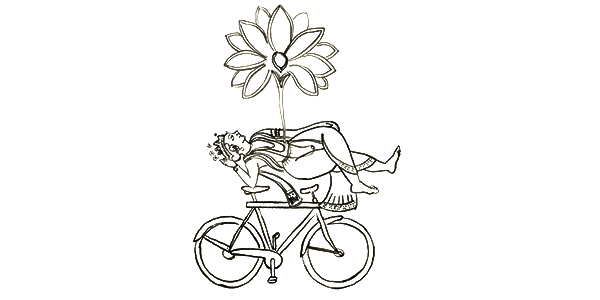
Frédéric Lère La Bicyclette

Frédéric Lère

“My grandfather was born in Paris, he started in the circus very young–he must have been around sixteen– in 1914. Apparently this circus was a hit, and the whole troupe was hired to tour the United States. They came over on a boat, and since this was 1914, during the crossing war was declared. When the ship arrived in New York all the French passengers were told to remain on board, they weren’t allowed to disembark; they had to return to France with the ship because everyone was being called up, it was the mobilisation générale.  My grandfather watched his colleagues jump overboard and swim to shore because they didn’t want to go back to fight. But he didn’t jump, thinking that since he was so young he wouldn’t be called up right away, and the war would be over before he was drafted.

“So he returned to France without ever setting foot in the United States.

“But he was called up, and he was in a battalion called the Bataillon de Joinville, which was just for athletes. They didn’t go on combat missions, they just did sports–competitions and demonstrations, things like that–until the Battle of Verdun when they said, the time for fun and games is over! Now we need everyone. He was wounded, he took a bullet in the head. He had a scar, a kind of indentation, on his forehead.  And after that the trapeze, it was finished for him.

“After the war, since he was from the Auvergne, which meant the whole family was in show business, he opened a boîte,  a place like a cabaret or a nightclub. He performed there, and of course he had all his connections with circus people. Then, during WWII, when everyone fled Paris, he went to Tours. After the war he stayed on, and set up again there.

“When I was growing up, we all lived together, on a farm. My grandparents lived in a big house behind ours. It was wonderful. I didn’t get on with my parents very well, so I was always going to stay with my grandparents in their big old house behind our house.

“One day my grandfather bought a gymnastic apparatus with a trapeze, knotted cords, rings, smooth cords–everything for practicing circus numbers. It was an enormous thing. He said, ‘Now I’m going to show you all what I know how to do.’

“He got all dressed up in his trapeze costume and climbed on the apparatus where he struck a few poses, he did a few pirouettes–and then he fell.

“No one ever used that apparatus after that–we were all afraid of it.

“Because of that experience, I had a rather ambivalent perception of the circus. My grandfather talked about it as something absolutely fantastic, with all his stories of voyages and things he’d seen, but in fact, all I ever saw of it myself was the dangerous side.

“The first circus in my own work came about when I was doing frescoes. I found the process of fresco painting so dangerous, I said to myself  I must paint something really dangerous to express the danger of the fresco itself, so I painted circus performers, always in poses of delicate equilibrium.

“In fresco painting, you have up to five hours to paint, and after that it’s over, finished! You can’t correct or add anything. The fresco is done. Everything that is wrong, well, it’s there–all the flaws are there, right along with whatever came out well. It’s a real balancing act. You start at one end of the cord, and you walk on a wire across the whole distance of the circus.  And if you fall, well then, you fall.

“For La Bergamote, I made a wall mural for their first shop in Chelsea. I liked what they did, but I felt the decor was a bit… cheesy. I felt they needed something a little more French, more traditional –because it’s really traditional and authentic, what they do.

“The most important thing, when you go into a place you like, is that if you can contribute to making it nicer, that in itself is the best reward.

“Then they opened a second boutique on 52nd Street and they decorated it in the same non-descript style as the first one. After only two years the decor was falling apart, so they had to completely redo the place and they asked me to make a new mural.

la-bergamote-mural

Frédéric Lère

“Here you have chariot crossing the Place Stanislaus in Nancy, making the first delivery of the bergamot from Calabria.*

“Remember this image of the horse and carriage in the exhibition? I thought it was such a gas, I absolutely had to take that for the point of departure of my mural.

“Instead of the orchestra, here I have the pastry chefs who toss bergamot candies from the chariot into the crowd. And the two people driving the chariot, are, of course, Romain and Stephane, the owners of  La Bergamote.

“When I paint, what I want to achieve is not, ‘Look at me, I’m so gorgeous,’  but to express an action.

la-bergamote_esquisse

Frédéric Lère

The arrival of the bergamot in Nancy is on permanent view at La Bergamot , 515 West 52nd Street. The FREEvolous King Lère Show is a public art installation which has been traveling around the world and on the web since December 2012, when it launched at Cup Cake Café. Since then, Frederic has given several small free-standing reliefs of circus scenes to friends who take them around the world.

The tiger act was last seen at the Bouglione Circus in Paris.

To see more of Frédéric’s work, visit his site, or  La Bergamote.

la_bergamote_map

On June 18, he will be painting the Empire State Building from the terrace of the Spring Hill Suites in Midtown at 25 W 37th St. from 4 to 7 pm.


Blondie of Arabia

t.e. lawrence

Monica Hunken moved to NYC two days before September 11 bringing with her a family background that included a failed whistle-blower lawsuit and an intrepid immigrant grandfather.  These turned out to be fertile soil for the agit-prop street theatre, political action and bike culture that flourished in the wake of the World Trade Center attacks, the Afghanistan and Iraq invasions and the 2004 RNC protests.

In 2010, inspired by Follow the Women, group ride for human rights that takes place in the Middle East annually, and enabled by a serendipitous catering gig in Qatar that provided the starting point, she embarked on a 6-week solo bicycle trip across Egypt, Jordan and Syria.

A brief description of this gay outing to a longtime peace activist friend elicited “That must have been quite a shock for the locals.” Truer words were never spoken. But it’s amazing what a six-foot tall blonde American can get valium for felines away with in a region whose inhabitants are bound, on the one hand, by the laws of hospitality, and, on the other, intimate knowledge and fear of the weight and caprice of American state power.

Bringing a “disconcerting American optimism” as she set off just a few weeks before the debut of the Arab Spring, Blondie of Arabia pedaled right into the very heart of the cultural-social maelstrom that is the Middle East, blueballing a series of gallant gentlemen along the way and blithely delivering a terrific whack to any number of gender clichés and hetero-normative sexual political assumptions nestling in a bouquet of  Orientalist geo-political post-colonial paradigms and islamo-phobias, as only a woman riding a bicycle alone through Aqaba can.

Safely back on Bleecker Street three years later, she plays it all for laughs for a brisk and thought-provoking hour at Culture Project, nightly through May 11.

monicahukenphoto-main


Meditate or Die

tantraMy friend Luc told me that biking is the perfect meditation. I sighed and said in my pious enlightened voice “So true.” My imaginary skeptical voice scoffed and said “Oh God here we go again.” He was referring to my history with meditation; I am a dilettante of spiritual traditions.

NYC is Candy Land for spiritual seekers like me. I’ve taken all the yogas: hot, naked, Kundalini, and laughing. An acupuncturist using electrified needles has worked me over more than once. The herbal oil enemas were transcendent, but wrecked my furniture. I took the 12 steps and turned my life over to the care of a doorknob.

It was expensive, but I loved all of it and regret nothing. One of the smartest purchases I made was the $250 I spent on the secret mantra. I have been meditating with it sporadically for 16 years, so I feel well qualified to judge whether or not biking is the perfect meditation.

Let’s compare the two.

Meditation Biking
Gently close your eyes DO NOT CLOSE YOUR EYES
Sit in a comfortable, upright seated position Wedge a piece of plastic mounted on a clattering aluminum frame between your ass cheeks
Slow your breathing Gasp for breath
Bring your focus to a single point Only Chinese delivery guys are qualified to do this
Play gentle, calming music Sift crucial sounds from 85dB of city noise
Activate your calming prefrontal cortex Fire up the amygdala. It’s fight or flight time, baby.

On paper, biking is about as meditative as a Rammstein concert.

But is it?

After crashing into a limo on 6th Avenue and being doored in Chinatown in the first week of my bike commuting experiment, I realized that spacing off while hurtling through a gauntlet of cars is deadly. There are hundreds of harmless things on the streets that can turn perilous in an instant. All my senses must be focused on everything at once and my reactions must be agile enough to evade danger. When my mind is occupied in this way, the chatter nearly stops. I’m forced to be in the moment.

While in this state, the ride is sensuous and I feel everything intensely. Rhythms emerge from the din. I float across dunes of asphalt formed by pounding tires. Sound is hushed when I turn off a busy thoroughfare onto a side street and the kaleidoscopic city turns into a quiet little town. I fly down the avenues with pigeons on a magic carpet. It’s exhilarating. And then the ride ends.

Luc was right. Biking in NYC is the perfect meditation.

meditation


It’s Still Winter

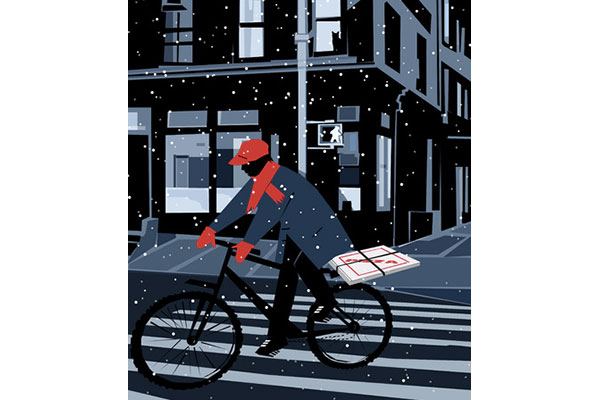
kim de marco img

Apparently it’s going to continue to be winter until at least the end of the week. Lots of people are talking to me about how long the winter is feeling this year–I suppose that’s to be expected when can a person get off ativan it gets such an early and spectacular start with a hurricane.

While wading through the wind and rain, focus the mind’s eye on Kim De Marco’s better world. (and see more of her work at kimdemarco.com)

Am I Invisible? Open Call

Am I Invisible? Call for Photography Meet the Jury!

go to open call

Bicycle is thrilled to announce Am I Invisible? Call for Photography jury!

“Am I Invisible? A Portrait of New York Bicyclists” is an open call for photographs and photography-based art that capture the style and diversity of New York City’s distinctive bicycling community. A portion of the entry fee will be donated to Transportation Alternatives, New York City’s oldest and largest transportation advocacy organization.

For more information about Am I Invisible? and to enter a photograph, go here.

Pasqualina Azzarello, Visual Artist, Executive Director of Recycle-a-Bicycle 
Pasqualina Azzarello is deeply involved with New York City, both as a public and installation artist and as Executive Director of Recycle-a-Bicycle, a community-based bike shop and 501(c)(3) non-profit organization that facilitates job training and environmental education. Through innovative programs such as Earn-A-Bike, Green Jobs Training Programs, High School Internships, Recycled Arts Workshops, Summer Youth Employment Program, and Kids Ride Club, RAB is dedicated to the health, development, stewardship, and empowerment of NYC youth.
More about Recycle-a-Bicycle here

Elizabeth Zechella, Editor, The Metropolitan Museum of Art
Elizabeth Zechella, originally from Athens, Georgia, landed in New York City eight years ago by way of New Orleans, Paris, and the burgeoning metropolis of Annandale-on-Hudson.
Prior to the Metropolitan Museum of Art, she was an editor at Phaidon Press and a project manager at Andrea Rosen Gallery, New York. She volunteers for Transportation Alternatives and is a member of Community Board 4, where she serves on the Transportation and Chelsea Land Use committees.
She commutes from Chelsea to the Met on a basketed black Biria.
More about The Metropolitan Museum of Art here

Emma Raynes, Program Director at the Magnum Foundation
Emma Raynes, Program Director at the Magnum Foundation is also a media producer who also likes to play with sound, video, and book arts. A recipient of a Hine Fellowship from Duke University’s Center for Documentary Studies, she is at work on an ongoing a transmedia project about families of sugarcane workers in Brazil. Emma lives in Greenpoint Brooklyn and works on Manhattan’s west side. One of her favorite things in the world is biking over the Williamsburg Bridge on her way to work.
More about The Magnum Foundation here

Claire Fleury, Curator and Founder, Strange Loop Gallery
Claire Fleury is from Amsterdam, where bicycles rule. A writer, performer, fashion designer cialis vs viagra and curator, she has had many lives, including bicycle messenger in New York City. Her current bicycle is a Dawes.
More about Strange Loop Gallery here

Nona Varnado, Fashion Designer, Writer, Curator at Red#5 Yellow #7 Project Space
Nona Varnado is founder of the eponymous lifestyle cycling apparel line and curator of Red#5 Yellow#7 in Los Angeles. Part bike gallery, part pop-up shop, Red#5 Yellow#7 is a launchpad for the most interesting new cycling products and a resource for connecting people to new ideas.
More about Nona Varnado here

Accra Shepp, Visual Artist, Photographer, Visiting Assistant Professor at Pratt Institute
Accra Shepp’s work is represented in the Museum of Modern Art, The Chicago Art Institute, the Victoria and Albert Museum and the Whitney Museum of American Art. His work has been exhibited widely, notably a solo exhibition at the Whitney; his Occupy Wall Street work was seen in Brussels as part of the 2012 Human Cities Festival, and the Museum of the City of New York. A Fulbright fellow, he is the recipient of a NYFA fellowship. His favorite mode of transportation in New York City is a bicycle.
More about Accra Shepp here

Saul Robbins, Photographer, Curator, Educator at The International Center of Photography, Board Member Emeritus of the Camera Club of New York
Saul Robbins’ work has been exhibited at Griffin Museum of Photography, Maryland Institute College of Art, Museum of Fine Arts in Houston, New Orleans Photo Alliance, Portland Art Museum His curatorial projects Projecting Freedom: Cinematic Interpretations of the Haggadah (2010), Regarding Intimacy (2007), and No Live Girls, Peep Show 28 (2002). His favorite bicycle is a 1960s Mercier women’s 5-speed
More about Saul Robbins here

John Stanley, Director of the Camera Club of New York
John Stanley is the recipient of the Paula Rhodes Memorial Award 2009. He was Education Coordinator at SF Camerawork (San Francisco) and taught ICP Teen Academy, Grand Street Settlement and the Bronx’s Cinema School. His photographs have been exhibited at Edward Hopper House Art Center, Nyack, NY, at P.S. 122 Gallery, Visual Arts Gallery, and Envoy Enterprises in NYC, and Photo Center Northwest, Seattle. After years of not using a bike, John is a proud bike owner who can’t wait for warmer weather.
More about the Camera Club here
More about John Stanley here 


go to open call

Happy New Year!

A Band on Wheels

Mr F.W.Painter, the well-known cycling instructor and
bandmaster of the Christchurch Professional Band, intends shortly to
introduce to the public a novelty in the form of a bicycle band.
Several members of the Professional Band have been practising,
assiduously for some time past, and cialis at a rehearsal this morning they
showed considerable proficiency in playing their instruments while
cycling. On a more suitable ground than that at the drillshed they are
able to perform several manoeuvres on their wheels.
The Star (New Zealand), 13 April 1898, Page 3 


go to open call


An Excursion to New York City’s Museum 7.28 Mile

Although there is no shortage of excellent reasons to go there, starting with an astounding collection of museums, not to mention Central Park, one of the greatest gifts of any city to its citizens since the first brick was laid in Mohenjo Daro, trying to get to the Upper East Side on a bicycle, and getting around once you’re there, is difficult.

A very pleasant riverfront bike path will bring you from Whitehall as far as 35th Street, passing, spectacularly, beneath the Brooklyn, Manhattan and Williamsburg bridges, along the way. Sadly, a few blocks beyond the splendid new East River Ferry Terminal, the idyll ends in a trash-filled cul-de-sac.

Further progress uptown requires heading inland where the choices will inevitably come down to First and Park Avenues, both highways.

Despite the recent installation of a bike lane on First Avenue, which is a pure delight on the weekend when there is no traffic at all and it is routine to sunbathe, or barbecue, or play every single one of Bach’s Goldberg Variations, or all three, simultaneously or consecutively, in the middle of that most spacious thoroughfare without the worry of being disturbed by a single automobile, or elephant, or even the police. Apart from these golden moments, I cannot, however, recommend this noblest of bike lanes, “sharrowed” as it is at several points by ramps and routes delivering motorists who will not even see you as they careen toward Queens and Long Island, so bedazzled is their mind’s eye by visions of the joys that await them in those Valhallas beyond tunnel and bridge.

As in Midtown, bike lanes are few, but unlike that chaotic throng of highways masquerading as city streets, traffic above 59th Street is usually light and as such in thrall to frantic motorists trying to make all the green lights between the Bronx and the Mid-Town Tunnel.

Are there elephants in that tunnel, or something?

Only sometimes. And were this a regular thing, it would just be one more thing to complain about.

So what’s the rush?

If accidents, whether provoked by bicyclist or motorist, are generally the result of moving faster than the brain can send instructions to the body, between the euphoria of the speeding motorist and the apoplexy of the traffic jam, I prefer the perils of the latter. The damage inflicted by the most neurasthenic cabdriver advancing at 15 miles an hour will be preferable to that of the gayest motorist roaring along at 50 miles an hour in a 30 mile zone.

This is bicycling on the Upper East Side. Possibly a situation that will always be less than ideal. One might get the impression we are just not wanted.

Things being what they are, I say, take Park Avenue.

One evening a couple summers ago I found myself stopped at the light at Park and 42nd alongside a pedicab driver. If anyone knows the best way to get to the Upper East Side on a bicycle, I thought, it’s this guy.

“Hello,” I said, experimentally.

“Hello!” replied the driver brightly.

The two people seated in the cab flicked a glance in our direction, then paid no more attention to us.

“Can I ask you a question?” I said. And I laid my case before him.

“Sure!” He nodded affably. “Just go up here, turn left, then right onto Vanderbilt, then india generic cialis right again on 46th, and you’ll be right back on Park. What’s your name?”

I told him.

“Harry,” he said, pointing at his chest. He was in fact quite hairy, in the manner of a guy who likes to wear colorful large-patterned shirts that show off to their best advantage a springy crown of sun-bleached hair framing a ruddy outdoor complexion. He was wearing one of these.  Large orange flowers bloomed on an eye-popping yellow background.

“Your hair is great,” he added.

I thanked him, and returned the compliment.

The light changed and we pushed off.

“How do you like that job?” I asked, taking advantage of slow-moving traffic to ride alongside him.

“It’s alright,” he said, “It’s good.”

“What about the winter?”

“In the winter I’m in Florida!” he said with the wide grin of a man who has no prejudice against sloth, yet has never in his entire life been bored for even one second.

“And the summer it’s really nice, you’re outside, the money’s good…”

We turned left on 42nd, and I had to pull ahead of him until we turned into Vanderbilt Street.

Thinking more about the interrupted conversation behind me than what lay ahead, I kept going straight instead of turning where he’d told me to.

“Jeanne!” I turned to find Harry waving broadly toward the right as he turned into 46th Street.

I waved back, but I didn’t see him again.

It’s unfortunate that the Museum of Art and Design has such a dull name–and somehow MAD doesn’t seem like it will ever have the appeal of “MoMA” or “The Met”–because it is one of the city’s most beautifully proportioned museum, inside and out, in both form and substance.

There are far too many museums on the so-called Museum Mile than you could possible visit in one day or three, even should you scurry through the galleries of, say, MoMA strictly refraining from even a glance at the art as you conscientiously photograph each and every one of the wall labels with your smartphone.

When I saw this I was in the company of a friend visiting from out of town. We got a terrific laugh out of it, once we recovered from the slack-jawed staring. Few things in life are as delightful as a good laugh in a place where one isn’t supposed to even smile, much less find anything funny. When I’m dead it’s one of the things I’ll miss the most.

Without looking quite so far ahead, unless you are a memory expert, visiting more than two museums a day is pointless, and of these, one of them should be on the small side. If you employ this method: one large museum plus one small one, between the two a pleasant snack and ending with a breezy roll around Central Park to wind things up, in a minimum of three months of weekends you will have visited them all, and it will be time to start  over.

Although possibly empty of Vermeers, Michelangelos or Monets, each of the city’s smaller museums will reveal to the visitor something which can never be spoiled by over-familiarity or anticipation: surprise.

As for the Museum of the City of New York itself, you really have to wonder how they managed to fit the entire city in a single building.

It must have quite a large basement.

NY Art Book Fair at MoMA PS 1

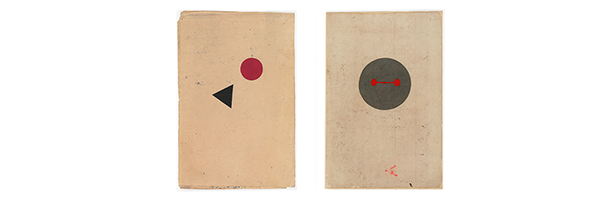
werkplaats typografie

Fall doesn’t really begin for me until Printed Matter’s NY Art Book Fair at PS 1. I go every year, and every year it seems like it’s better than the year before.

Something about literacy seems to encourage a particular kind of hob-nobbing, cheerful flamboyance. This year the ambience of fearless bonhomie is perhaps due at least in part to M. Wells , currently in between locations, serving up excellent snacks in the PS1 café.

The first time I went I seem to recall being able to get through the entire thing opening night, despite spending quite some time with a publisher from Pennsylvania who had brought a small collection of large, smooth rocks to keep him company during the fair. It was the extremely pleasant discussion of the life story and occupations of these rocks that made me linger at his table far longer than could be considered efficient. But even without such unhoped for, impossible to imagine opportunity for uplift, in recent years, between the sheer quantity of wonderful things to look at, not to mention interesting people to talk to, it takes me several hours just to get through the zines, requiring more than one visit. Worse things can happen.

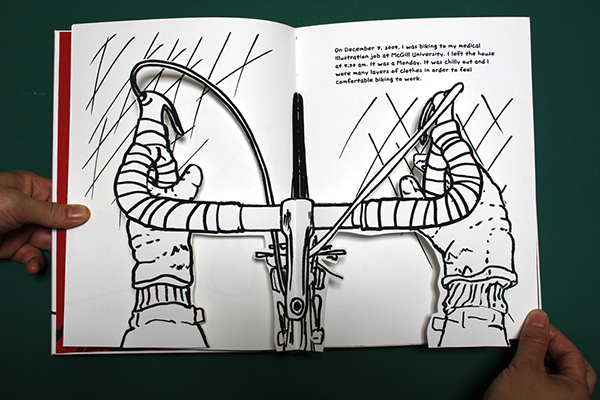
While I use a bike to get to the fair, I don’t usually expect to Levitra find anything like Jenny Lin’s Skinny Leg, a hair-raising, and page-raising, pop-up book and zine that tells the story of her bicycle accident and how she lived to ride again. Her pop-up engineering is great and full of imaginatioon, so not surprisingly, we found out we are both fans of Sam Ita. She has one of his books, and I have all of them.

Jenny’s book is published by the excellent B&D Press  back at the fair with a new Judith Butler zine in their series “The Life and Times of Butch Dykes  a “series of fanzines about the lives and times of amazing women”

It would take all day to mention everything noteworthy, thrilling and delightful, such as Louis M. Schmidt , Cinders Gallery , Fantasy Camp, just to mention a few–but I’d rather get back to the fair for an egg sandwich and a closer look at what’s new from Picturebox.

Bike parking would be nice at some point. Meanwhile, I’m making a note to myself to remember, on a day when our species has got me down: there are way, way more book lovers than there are parking meters and bus stop signs in Queens.


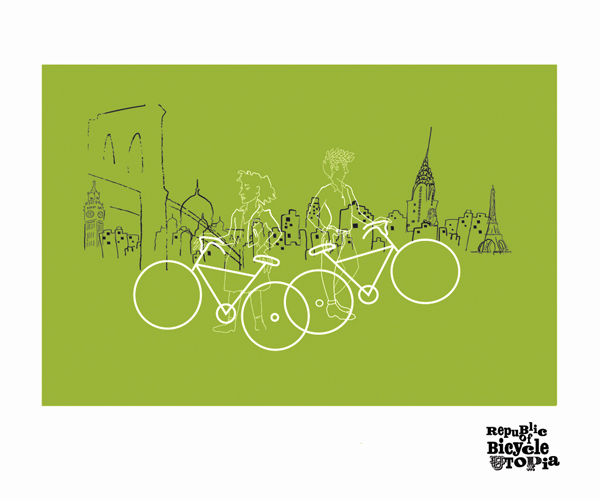
The Republic of Bicycle Utopia with ArtCrank at Interbike!

The Republic of Bicycle Utopia


Here at Bicycle Utopia we are thrilled Propecia to have been a part of ArtCrank’s poster exhibition at Interbike in Las Vegas last week!

La prise de l’Etoile

As in Place de l’Etoile vigrx substitue, and urban theatre.

[tentblogger-vimeo 37561802]